How Fordism and Fascism Gave Birth to Modern Car Culture
In 1934, writing from his prison cell, Antonio Gramsci reflected on the sweeping transformations reshaping industrial production in the United States. The rise of the automobile and the wider Fordist factory, he argued, signaled a new economic and moral order,
In 1934, Antonio Gramsci, incarcerated in a cell, contemplated the profound changes in industrial production, particularly in the United States. The automobile industry and the Fordist factory system, he observed, heralded a transformative economic and moral era. This system, Gramsci argued, subjected workers to strict discipline, elevated the significance of wages, and blurred the boundaries between production and personal life.
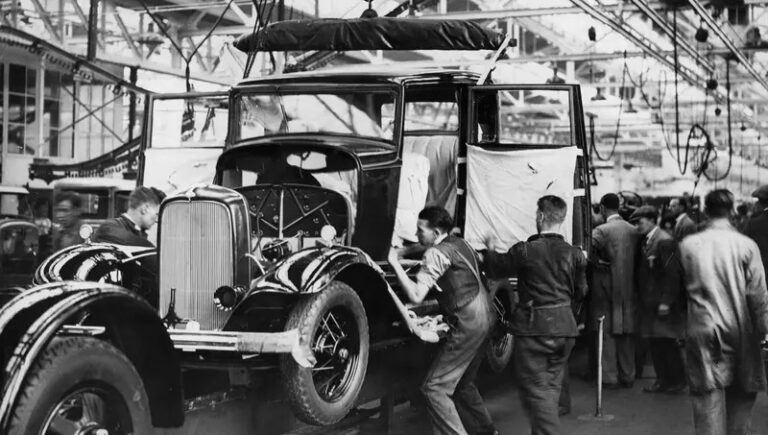
Key to this order were the assembly line and vertical integration. Ford's introduction of the moving assembly line in 1913, which compelled workers to repeat identical, easily mastered tasks, significantly enhanced productivity. Concurrently, the direct supervision of all inputs and distribution—from rubber plantations to railway networks—resulted in reduced production costs, leading to lower prices and higher-than-average wages.
The assembly line, Ford believed, was inspired by his visits to slaughterhouses in Chicago and Cincinnati, where animal carcasses were meticulously moved between butchers on overhead conveyor belts. He then applied this mechanized efficiency to car manufacturing, where parts moved between stationary workers rather than workers moving between parts—a concept borrowed from Frederick Winslow Taylor's scientific management.
Taylor also aimed to eliminate any "human content" from work, standardizing it into what he called a "trained gorilla." This led to a diverse workforce, with fifty different languages spoken on Detroit's assembly lines, comprising mostly southern American, European, and Middle Eastern migrants. The ideology surrounding Fordism extended beyond the factory.
It was complemented by "extremely subtle ideological and political propaganda," in Gramsci's terms. Workers were not only compensated for their labor, but also for their conduct: their temperance, thrift, and domesticity. The Sociological Department monitored employees' private lives—what they ate, drank, and how they lived. Despite being eventually abandoned due to cost, this system aimed to equate producers with virtue.
Far from merely disciplining laborers, Ford sought to create moral industrial citizens—men capable of volunteering for any industry, should the economy falter. This ambition was rooted in the belief that these workers would serve as "master in industrial method," contributing to the nation's welfare. High wages, introduced in 1914 as a "family wage," formed the basis for the male-breadwinner model, emphasizing the wage's moral dimension and legitimizing a segment of the working class as bourgeois.
This wage bolstered norms of working-class consumption, as Ford famously declared, "the workers will buy automobiles." By separating workers from the means of production and encouraging consumption, Ford aimed to deepen their investment in the relations of production. However, this control over inputs and distribution served a dual purpose: to lower production costs while maintaining strict control.
Ford's vehement anti-Semitism, evident in his distribution of anti-Semitic literature through his newspaper, the Dearborn Independent, further underscored this ideology of the producer. He championed the industrious individual, rebuking those who speculated instead of laboring, echoing the philosophies of late nineteenth-century Midwestern populism.
This moral economy, grounded in "producerism," opposed the speculation-driven profit-making by financiers and rentiers, advocating for a society where the producer contributed to the nation's wealth, not the other way around.
Written by urgent.news from Literary Hub's reporting — not their text. Machine-written — may contain errors; check the original before relying on it.