Ask Ethan: Are there really charm quarks inside the proton?
At the start of the 20th century, we were still figuring out what the structure of matter was. We knew everything was made up of atoms, and that there were negatively charged electrons within them, but the rest of the atom was a mystery. Over the course of the past 125 years, we subsequently learned that there was a small, massive, positively charged nucleus anchoring every atom. That nucleus…
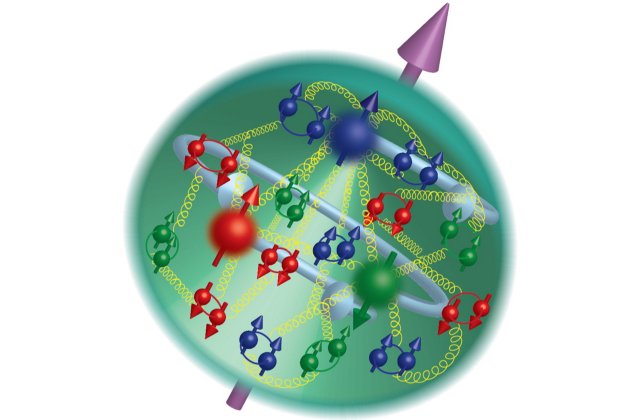
In the early 1900s, scientists were still grappling with the structure of matter. They knew that atoms were composed of negatively charged electrons, but the composition of the atom's nucleus remained a mystery. Over the past 125 years, scientists discovered that the nucleus is made up of nucleons - protons and neutrons - which are themselves made of quarks and gluons. Protons are composed of two up quarks and one down quark, while neutrons contain two down quarks and one up quark.
However, there are four other fundamental types of quarks: strange, charm, bottom, and top. These heavier quarks are typically not found within protons, as they are more massive than the proton itself. This raises the question: how can charm quarks be present within protons? Our Patreon supporter, Aaron Weiss, wonders about this conundrum, stating that charm quarks are heavier than protons, so how can they exist within them? The answer lies in the way the strong force works and the concept of quarks forming bound states.
The strong force is responsible for binding quarks together to form stable particles, such as protons and neutrons. According to quantum chromodynamics, each quark carries a "color charge," while gluons carry a "color-anticolor" combination. Only combinations of colorless particles, such as three quarks or three antiquarks, are allowed as bound states. This is why protons and neutrons are colorless entities.
Even though the individual quarks are not directly observable, their interactions through the strong force and the "residual" force carriers, such as pions, can be directly observed. When probing the internal structure of a proton, scientists fire other particles at it, such as protons, photons, or electrons. The electron is an ideal choice for this purpose due to its fundamental, point-like nature and its ability to interact with quarks without being affected by gluons.
By studying the collision debris, scientists can piece together the composition of the proton, including any charm quarks that may be present.
Written by urgent.news from Big Think's reporting — not their text. Machine-written — may contain errors; check the original before relying on it.