After an Eight-Year Journey, Two Spacecraft Have Begun Their Arrival to Mercury, the Inner Solar System's Most Mysterious Planet
The BepiColombo mission, by the European Space Agency and the Japan Aerospace Exploration Agency, is only the third to study our smallest planetary neighbor
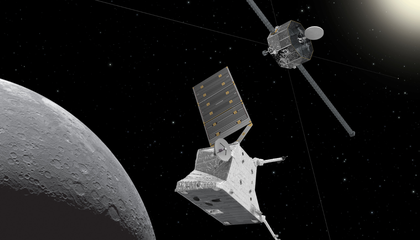
After a grueling eight-year journey, the BepiColombo spacecraft will reach Mercury today, brimming with the potential to unlock secrets of the smallest and least understood planet in our solar system. Developed jointly by European and Japanese space agencies, the mission set sail from Earth in 2018, embarking on a winding path to explore Mercury's hostile environment.
As the spacecraft prepares for its arrival, ESA's mission manager, Santa Martinez, describes the arrival phase as its "most operationally challenging planetary arrival sequences ever attempted." The extreme environment near the Sun presents a unique set of challenges, as Mercury's weak gravitational pull makes it difficult for spacecraft to approach without succumbing to incineration or being lost in space.
The spacecraft had to traverse more than 10 billion kilometers, performing nine critical flybys to perfect its trajectory and speed up or slow down as needed.
Once the craft reaches Mercury, it will separate today at 1200 GMT, releasing two probes attached together: the Mercury Planetary Orbiter (MPO) and the Japanese Mercury Magnetospheric Orbiter (Mio). These two probes will study Mercury's surface, magnetic field, and space environment, respectively, from elliptical orbits ranging from just 480 km to 11,000 km from the planet's surface.
Given the 30-minute delay between ground commands and the spacecraft's execution due to its distance from Earth, the operations will be autonomous. This adds another layer of difficulty to the mission, as the spacecraft must handle various tests, including releasing the probes, thermal controls, propulsion, and altitude systems. Despite potential challenges, the team remains prepared and flexible, ready to handle any unexpected issues that may arise.
The mission has faced setbacks, including a thruster glitch in 2024 that caused the spacecraft to flyby closer to Mercury than planned, thereby altering its trajectory. As the next phase approaches in December, when the probes will separate into their respective orbits, the mission team remains vigilant, acknowledging that Mercury is the least studied among the four rocky innermost planets in our solar system.
With sixteen instruments and a €1.7 billion budget, BepiColombo promises to bring unprecedented views of Mercury, promising to open a new chapter in our understanding of the solar system.
Written by urgent.news from Malay Mail's reporting — not their text. Machine-written — may contain errors; check the original before relying on it.
This story
This is one outlet's version. Read the fullest account.