Scaling agentic AI pilots across the enterprise
As agentic AI moves from experimentation toward enterprise deployment, the challenge is figuring out how agents can work together, connect to the systems and data they need, and operate safely across the workflows that run a business. Although agentic AI has been adopted by some 80% of Fortune 500 companies, progress toward meaningful scale remains…
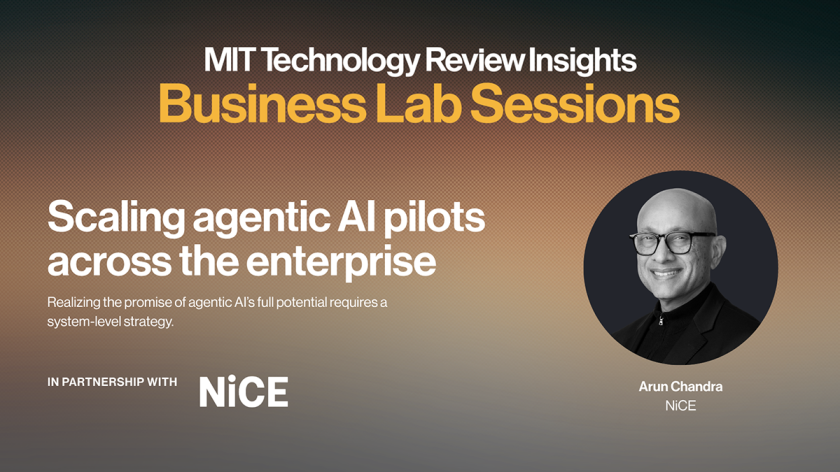
Agentic AI technology is being rolled out across businesses, but scaling these agents across an enterprise proves challenging. Currently, 80% of Fortune 500 companies have adopted agentic AI, yet progress toward widespread implementation is uneven. Many firms are still running isolated pilots before moving to full-scale deployment.
For NiCE's chief operating officer Arun Chandra, the initial step is moving beyond experimentation. "Everybody's trying to figure out what can we do with this technology?" he explains. However, scaling requires a clear link to business strategy. Organizations must decide if they aim to boost revenue, cut costs, or pursue other strategic or financial goals.
Once defined, they must rethink the workflows where agents will function, rather than merely adding AI to existing processes. Chandra cautions against applying AI to outdated or inefficient workflows.
To operate effectively, agentic AI agents need access to relevant data, knowledge, and context, as well as connections to back-end systems to execute actions. Disconnected information can hinder their capabilities: "The efficacy of these AI agents is purely a function of the context, the knowledge, and the data they can ingest and use," Chandra emphasizes.
Scaling agents may also introduce fragmentation if teams develop isolated systems that don't communicate with each other. As agents take on more significant tasks, governance, privacy, security, and change management become even more critical. Chandra believes AI agents should be held to the same standards as human employees, integrating their workforce similarly to a blend of humans and AI agents.
Looking ahead, a connected approach could enable agents to operate proactively and even communicate amongst themselves to address customer needs. For organizations transitioning from isolated pilots to scaled operations, the priority isn't to "boil the ocean." Instead, they should devise a connected strategy centered around high-value use cases, workflows, workforce modifications, and quantifiable results.
This webcast was produced in collaboration with NiCE. Insights, MIT Technology Review's custom content division, created the material, overseen by human researchers and writers.
Written by urgent.news from MIT Technology Review's reporting — not their text. Machine-written — may contain errors; check the original before relying on it.