Raumfahrt: Kritisches Manöver an Merkur-Sonde „Bepicolombo“ geglückt
Ein Manöver an der Merkur-Mission galt im Vorfeld als kritisch. Monate trainierten Experten verschiedene Szenarien.
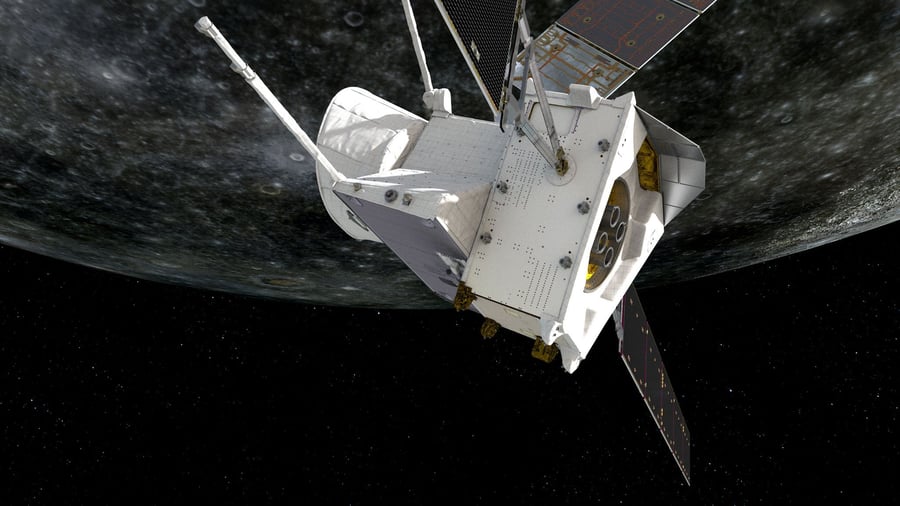
After a journey of eight years through the inner solar system, the Mercury probe "Bepicolombo" successfully separated a propulsion module at the designated point for exploring the smallest planet. The critical maneuver, previously described as a "high-risk operation," concluded after traversing billions of kilometers, as reported live from the European Space Agency's control center in Darmstadt.
The two orbiters on board are now on their way to their planned orbits. Mercury is the least explored planet in the inner solar system, with the €1.7 billion joint mission between the European Space Agency and Japan's space agency, Jaxa, aiming to uncover more about this small world. According to the ESA, Mercuries has many unanswered questions, such as examining the magnetic field, the surface, mapping it, studying its core and gas layer, and gaining insights into the formation of planets.
The critical separation of the unused propulsion module posed a high risk, with only one chance for the two orbiters to enter their correct positions into different orbits afterward. Preparations for the mission involved training various scenarios over the past months. Due to the vast distance, corrections would only be made minutes later, with signals taking eleven minutes to travel from the probe to Earth and back.
Following the separation, "Bepicolombo" will now fall freely towards Mercury, according to the Technical University of Braunschweig. The main challenges include the proximity to the sun, its gravitational pull, and extremely high temperatures. Now, the plan is for the two orbiters to separate on the ninth of December and then enter their respective orbits in December and March. Scientific work of the mission is expected to begin in April.
Written by urgent.news from Handelsblatt's reporting — not their text. Machine-written — may contain errors; check the original before relying on it.