Nvidia’s new PAIR software uses idle home PCs to speed up AI tasks
Nvidia’s new PAIR software turns every idle PC in your house into a shared AI cluster, free, open-source, and live in beta starting today.
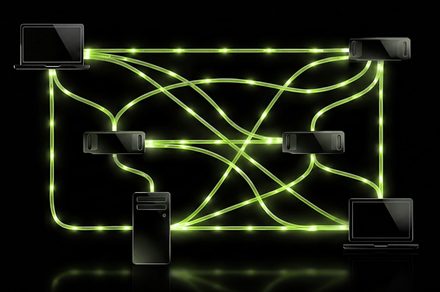
Nvidia has unveiled a free software called PAIR, short for Personal AI Router, designed to harness the idle computing power of home PCs to accelerate AI tasks. The open-source software pools the unused GPU power from computers connected to a local network, efficiently distributing complex AI tasks among these idle resources. This approach effectively transforms downtime into valuable computational time without requiring any additional hardware purchases.
Once installed, PAIR automatically identifies idle PCs on the home network and establishes secure, encrypted communication channels. It then routes AI tasks to computers with available computational power, ensuring that actively used PCs are spared from unnecessary workload. According to Nvidia, many American households possess at least two PCs, but these machines are only used for about 17% of the average day, roughly four hours.
By leveraging this idle time, Nvidia estimates that families could be wasting approximately 165 teraflops of processing power, equivalent to leaving a high-end gaming PC unused for an entire day. To demonstrate the financial impact, Nvidia asserts that running these idle machines at 60% utilization could process around 120 million tokens per day with a mid-sized open model or several million tokens per hour with a larger model.
Outsourcing AI workloads to cloud-based services would otherwise cost around $1,200 a month, plus additional electricity expenses. The beta version of PAIR is now available for Windows, macOS, and Linux, supporting NVIDIA RTX 20-series GPUs and newer models, including RTX PRO workstation cards, DGX Spark, and Apple M4 or newer Macs.
Additionally, Lenovo is leveraging IFA 2026 to introduce a range of creator-focused laptops powered by Nvidia's RTX Spark platform. These new Yoga Pro 9n and Yoga 9n 2-in-1 laptops are designed to cater to individuals who require substantial computing power for AI development, content creation, software development, and 3D rendering, all without resorting to cloud-based solutions.
Lenovo positions these machines as integral components of personal computing systems capable of handling increasingly sophisticated AI models locally, reflecting the broader trend observed at the event of brands developing products that can compete with or surpass Apple's offerings.
Written by urgent.news from Digital Trends's reporting — not their text. Machine-written — may contain errors; check the original before relying on it.
This story
This is one outlet's version. Read the fullest account.
- Nvidia PAIR makes it easy to create a household data center for running agentic AI tasks siliconangle.com
- Nvidia PAIR lets you put your idle Macs and PCs to work for AI agents thenewstack.io
- Nvidia PAIR utility joins every GPU in your home into a cluster for agentic AI tasks — tool uses spare cycles to keep agent swarms from hammering one GPU tomshardware.com