In an Age of AI, a Physicist Seeks What Endures
Sarah Demers, chair of the physics department at Yale University, sees the potential for large language models to both help and harm her field. The post In an Age of AI, a Physicist Seeks What Endures first appeared on Quanta Magazine
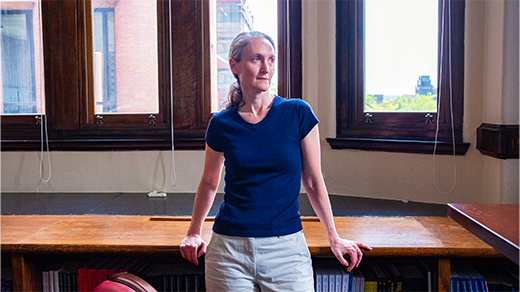
In July 2026, the U.S. Department of Energy chose 278 projects to support under its Genesis Mission, which aims to integrate artificial intelligence into scientific endeavors. One such project, led by physicist Sarah Demers, will utilize AI to assist in the Mu2e experiment at Fermi National Accelerator Laboratory near Chicago. This experiment seeks to detect a rare particle transformation, in which a muon turns into an electron.
Demers explains that AI can help optimize the experimental setup by controlling various aspects of the experiment, such as the duration of magnetic fields, their strength, and the placement of the target. She appreciates AI's ability to streamline the optimization process, making it "more of an art than a science." However, Demers, who chairs the physics department at Yale University, is not eager to incorporate AI into other aspects of her work or life.
Her concerns stem from the fact that popular large language models (LLMs) are trained on datasets containing others' intellectual property, often without proper attribution. In response to AI's emergence, physicists are grappling with fundamental questions about the nature of physics research. For Demers, who is spearheading an effort through the American Physical Society (APS) to draft an AI policy statement, these questions center on defining the enduring aspects of physics and articulating them clearly.
She emphasizes the importance of maintaining a skeptical approach to AI hype and ensuring proper attribution of ideas. Demers highlights that while AI can significantly accelerate analysis processes in experimental physics, such as at the ATLAS experiment at the Large Hadron Collider, new skills are needed to adapt to this rapidly evolving landscape.
An ongoing debate exists within the physics community regarding the impact of AI on the field, particularly concerning intellectual property and the responsibility of physicists in validating AI-generated information.
Written by urgent.news from Quanta Magazine's reporting — not their text. Machine-written — may contain errors; check the original before relying on it.