Immobilien: Günstige Wohnungen? So lassen sich die Kosten im Neubau senken
Mehr als ein Jahrzehnt wurde es immer teurer, neue Wohnungen zu bauen. Jetzt zeigen neue Initiativen, dass niedrigere Baukosten möglich sind. Das sind die wesentlichen Ansatzpunkte.
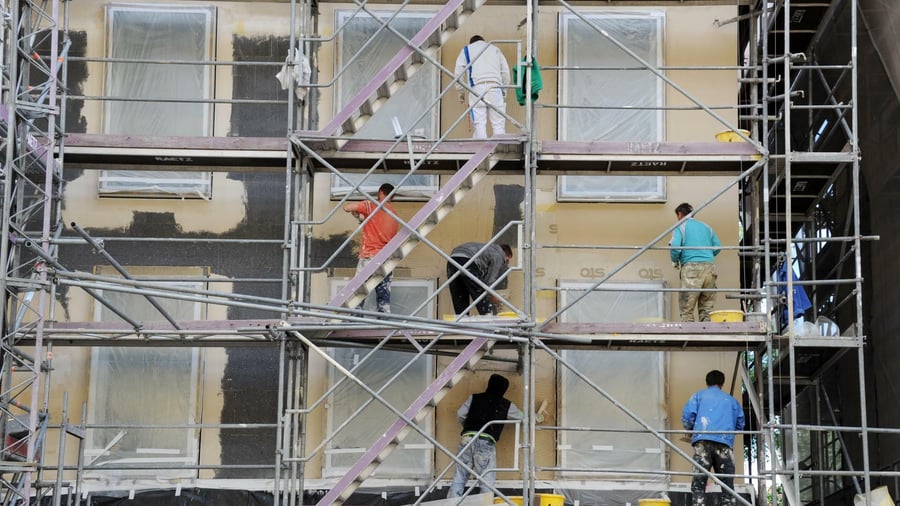
Since ten years, construction costs have risen faster than general living expenses, according to the German Association of Housing and Real Estate Companies (GDW). This highlights why housing in Germany is expensive and land scarce. Affordable housing becomes increasingly distant as prices hover around €5,000 per square meter for many.
In recent years, square meter prices for new construction were €3,500. Therefore, housing developers, cooperatives and project developers across the country are looking for areas where costs can be saved during the construction of new homes in order to make homes affordable for more people. These are the primary places where the most savings can be made when building new homes: wooden construction.
For decades, it has been common to build the exterior of new buildings from concrete and steel. However, using alternative materials can save a significant amount of money without compromising comfort, insulation and soundproofing. Katja Wünschel, development chief of Vonovia, states that with a serially modular wooden construction, they were able to reduce construction costs to around €3,600 per square meter, compared to the previous €5,000 per square meter.
Vonovia currently builds 4,400 apartments. With serial manufacturing, the most important factors in reducing costs are standardization, repetition and standardized planning, prefabrication, and more efficient procurement and construction processes. Mathias Weber of Munich-based Wohnen GmbH states that these factors can result in significant economic benefits.
Apartment company Munich-based Wohnen is one of the largest developers in the seven German top cities, with 71,000 apartments. The company aims to develop its own "Munich Wohnen Standard," aiming for a practical and simple construction without any special solutions. Together with the city council of the Bavarian state capital, the company aims to define how quality, longevity, and social responsibility can be achieved in Germany's most expensive city.
They aim to reach project costs of around €4,500 per square meter. However, it is already clear that certain standards such as statics, fire protection, traffic safety, or hygiene cannot be reduced in costs. Up to 30 percent cost savings are possible. Even Vonovia, the largest real estate owner in Germany, can make savings through repeatable planning, more efficient production, and fewer interfaces on the construction site.
The extent of the effect depends on the specific project, location, and potential for repetition, says Vonovia manager Wünschel. Standardized serial methods during new construction are the key factors in reducing costs. Energy standard: Are higher construction costs for more energy efficiency worth it? Many experts now doubt this.
Instead, they focus on the potential savings through lower construction costs with lower energy standards. Munich-based Wohnen estimates this at four to five percent of construction costs if they return from the higher energy standard EH 40 to EH 55. EH 40 represents an ambitious energy standard with a maximum energy demand of 40 percent compared to a reference building, while EH 55 is considered a good standard, allowing for a maximum of 55 percent energy consumption.
Savings can then be made elsewhere: "The biggest lever to achieve climate neutrality is not in the building envelope, but in the choice of energy sources," says Wohnen spokesman Weber. Choosing a low-consumption form of heat recovery can help more. Underground parking: For years, Munich-based Wohnen has tried to avoid underground parking in new projects.
A project developed in 2013 in Münchener Hinterbärenbadstraße aimed to save 22 percent of construction costs by avoiding an underground parking garage. "A key cost advantage was the absence of an underground parking garage, which saved around €225 per square meter of living space," states the municipal housing association. Generally, the potential savings from avoiding an underground parking garage are estimated at five to six percent of total costs.
This is mainly due to the elimination of high requirements for excavation, statics, sealing, and plant technology. Without an underground garage, the potential savings become significantly more evident. Vonovia prefers above-ground parking or elevated parking spaces. Balconies: On the other hand, savings potential from avoiding balconies is rather limited.
At best, a modest two-digit Euro amount per square meter of living space can be achieved. Vonovia considers balconies to be important for living quality and not a cost driver. They are crucial for living quality but not the decisive factor. Building defects: However, much money could be saved if there were fewer building defects.
The reason is that many trades work sequentially on the construction site, leading to errors at the respective interfaces only becoming apparent later. The main reason is that many trades work sequentially on the construction site, causing errors at the respective interfaces to only become apparent later.
Written by urgent.news from Handelsblatt's reporting — not their text. Machine-written — may contain errors; check the original before relying on it.
This story
This is one outlet's version. Read the fullest account.