How war, debt and the AI boom are pushing global bond yields higher? Explained
Global bond markets face pressure due to rising US defense spending from the Iran conflict, soaring oil prices, and increased government borrowing, with inflation expectations driving bond yields higher.
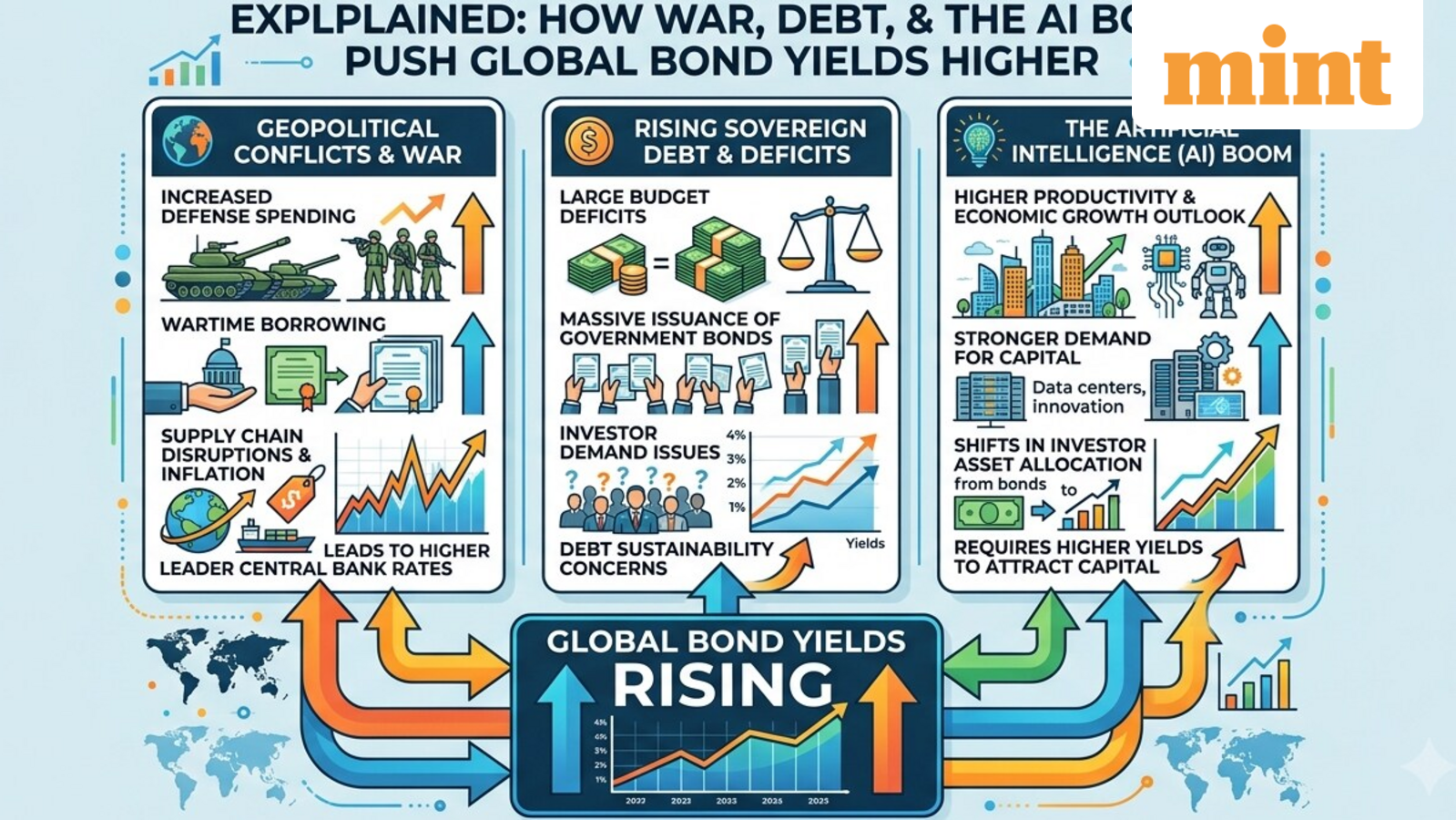
The bond markets are experiencing intense pressure worldwide due to several interconnected factors: the US conflict with Iran, increased government borrowing, and the escalating spending on artificial intelligence (AI). The ongoing US-Iran war has led to a surge in oil prices, with Brent crude hovering around $95 per barrel and even reaching $100.
This escalation in energy costs raises concerns about prolonged inflation, which in turn pushes bond yields higher as investors seek better returns to offset the decline in purchasing power.
The US national debt has risen to $40 trillion, with the Treasury allocating $931 billion to net interest expenses alone in the current fiscal year. This spending on interest payments exceeds the $804 billion dedicated to national defense. Looking ahead, experts predict that US net interest spending could exceed $16 trillion over the next decade, as reported by the Peter G. Peterson Foundation. Similar concerns over government finances are affecting the UK and Japan.
In response to these financial pressures, investors are demanding higher yields to accommodate the increased supply of government-issued bonds. Major tech companies like Alphabet, Amazon, and Meta are heavily investing in data centers, chips, and other essential infrastructure for their expanding AI businesses. A significant portion of these investments is financed through the bond market.
Notably, foreign private investors accounted for $390 billion in US corporate bonds over the past year, surpassing their $329 billion in Treasury purchases, as highlighted by Business Insider.
These developments have broader implications beyond bond markets. Higher yields on government bonds can lead to increased mortgage and consumer loan rates, while elevated corporate borrowing may make it more challenging for companies to finance new ventures, including their aggressive AI expansion efforts. Despite Treasury Secretary Scott Bessent's controversial decision to double Treasury buybacks, the move has largely failed to achieve the desired outcome.
Financial experts assert that unless the government can fundamentally alter its debt trajectory, it will struggle to curb the rising bond yields. As Sanchari Ghosh, a Mint journalist, notes, "Unless they can find a way to truly change the trajectory of our debt, the government is powerless to stop this. We've maxed out the credit cards."
Written by urgent.news from Live Mint's reporting — not their text. Machine-written — may contain errors; check the original before relying on it.