How Much Redistribution Will AI Require?
How much redistribution will AI require? A common scenario is that AI raises output enormously, but labor’s share of income collapses. GDP per capita goes up but workers get poorer, and making workers whole requires massive redistribution. In my latest paper, I run the numbers and conclude that this is probably incorrect. The idea is […] The post How Much Redistribution Will AI Require? appeared…
How much redistribution will artificial intelligence require? A prevalent scenario involves AI generating immense output, but labor's share of income dwindling. While GDP per capita increases, workers may become poorer, necessitating significant redistribution. My latest paper explores this concept, concluding that this notion might be inaccurate.
The core idea is straightforward: labor income equals GDP multiplied by labor's share of GDP. The crucial factor is the product. A smaller share of an economy that has grown considerably can still translate into more income for labor. Consider a situation where AI does not exist. Assume real GDP per capita expands by 2 percent annually, and labor accounts for 60 percent of GDP.
Now, project ten years ahead. To maintain labor's income growth at a comparable rate or higher, what is necessary? If AI boosts growth to 5 percent annually, GDP will be approximately 34 percent larger after ten years compared to the scenario without AI. Even though labor's share declines from 60 percent to around 45 percent, workers' collective income will remain equivalent to what it would have been without AI.
If AI accelerates growth to 10 percent annually—akin to the projections of figures such as Satya Nadella and Dario Amodei—the economy's size will be more than double the no-AI path. In this case, labor's share could plummet to 28 percent, yet the aggregate labor income remains about equal to the income without AI. Twenty-eight percent of an economy that has more than doubled is comparable to sixty percent of a smaller economy.
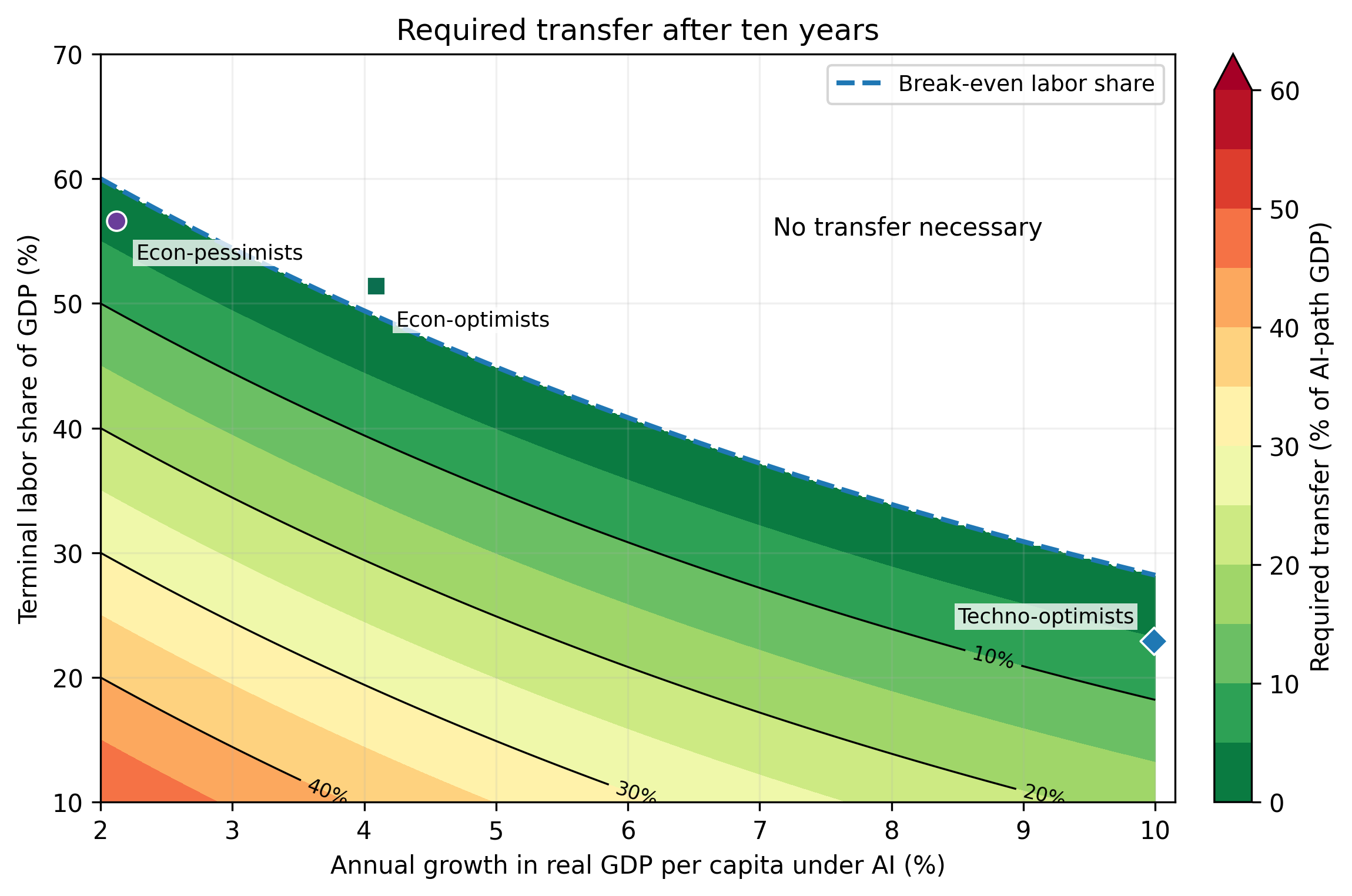
The accompanying graph illustrates the required redistribution over ten years across various scenarios. The white region above the dashed line indicates no transfers are needed. Which region do we currently find ourselves in? Let's examine three "stylized" depictions. An econ-pessimist, following Acemoglu, believes AI may displace some but relatively few tasks, as AI's productivity may not be sufficient to replace labor profitably in many instances.
Growth would only reach 2.1 percent, and labor's share would decrease to 56.6 percent, even though specific industries might still face challenges. The econ-optimist, echoing Tyler, myself, and Kevin Bryan, argues that automation can also create complementary tasks for humans. Growth may reach 4.1 percent, with labor and capital both benefiting without requiring any redistribution.
The techno-optimist, reflecting Amodei's view, presents the most alarming labor market scenario: three-quarters of labor income could be displaced, resulting in labor's share falling to just 22.9 percent. However, productivity growth would be substantial, generating an annual growth rate of 10 percent. The redistribution required to keep labor as a whole on its no-AI path would amount to only 5.3 percent of GDP.
Written by urgent.news from Marginal Revolution's reporting — not their text. Machine-written — may contain errors; check the original before relying on it.