Großer Vogelzug steht bevor: Erste Kraniche sammeln sich vor dem Abflug
Vor dem großen Abflug sammeln sich Kraniche in Deutschland – manche bleiben inzwischen sogar den Winter über. Wie der Klimawandel ihr Verhalten verändert - und den Nachwuchs gefährdet.
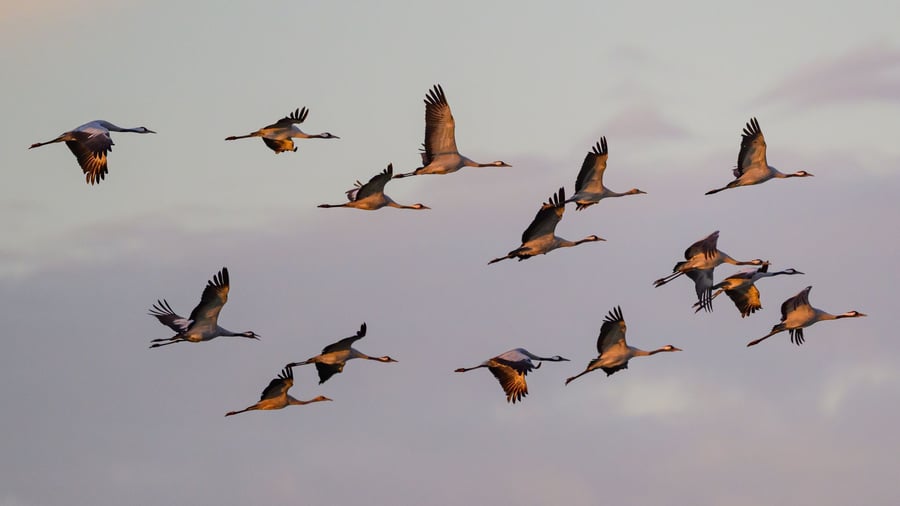
A massive bird migration is on the horizon as the first cranes gather at their large resting sites in the northeast of Germany, according to the crane expert Günter Nowald of the German Press Agency. Germany is home to more than 13,000 breeding pairs of cranes, with at least 200,000 to 300,000 cranes expected to congregate here during the autumn migration. These cranes mostly come from Scandinavia, Poland, and the Baltic region.
Germany is considered one of the most important crane gathering and resting places in Europe due to its peat landscapes around Darß, Stralsund, and Rügen. However, other resting places like the Rhin-Havel lagoon north of Berlin also host up to 60,000 to 70,000 birds in the evenings during the autumn migration. The peak of crane resting usually occurs in the first half of October, with the main migration to the south beginning at the end of the second half of October.
The exact timing depends heavily on wind conditions, specifically the tailwind for the southwesterly flight.
Nowald emphasizes that many cranes are no longer long-distance travelers. In fact, the total migration distance has decreased from an average of 1,700 kilometers 25 years ago to just 500 kilometers today. This change is attributed to milder winters and the absence of snow cover, which allows many cranes to feed on leftover harvests and thus skip the arduous journey when sudden weather changes occur.
The increase in crane populations in Germany has been considered a success story for conservation efforts. However, climate change now poses a threat to crane chicks. Between March and May, they require wetland habitats for nesting, such as raised areas in water. Unfortunately, recent years have seen a lack of rainfall during this critical period, leaving the flightless juvenile cranes vulnerable to predators like foxes.
Nowald advises maintaining a distance of 250 to 300 meters from nesting areas during the breeding season, as cranes need the water to remain still. Since cranes can live for over 30 years, the consequences of insufficient breeding success may only become apparent after several years.
During this year's crane migration, hundreds of thousands of imposing birds will travel over Germany, flying at an altitude of 100 to 400 meters, according to the Nabu ornithologist Bernd Petri. The autumn migration can be observed in all German states, as many cranes stop for rest at suitable areas. However, Petri advises observers to keep a respectful distance, as cranes are very sensitive to human presence and can become easily agitated.
Many white storks are also preparing for their migration to the south or have already departed. While most white storks in eastern Germany preferred the longer route over the Bosphorus to Africa, those heading towards Gibraltar are still taking their time. The storks that remain in Germany nowadays are predominantly western travelers.
Some birds from the Mediterranean region have even started to breed in Germany, including the inconspicuous chiffchaff and blackcap, which now breed in certain parts of the country.
Written by urgent.news from Handelsblatt's reporting — not their text. Machine-written — may contain errors; check the original before relying on it.