Anthropic’s Fable 5.1 and Mythos 5.1 bring improved coding and research capabilities
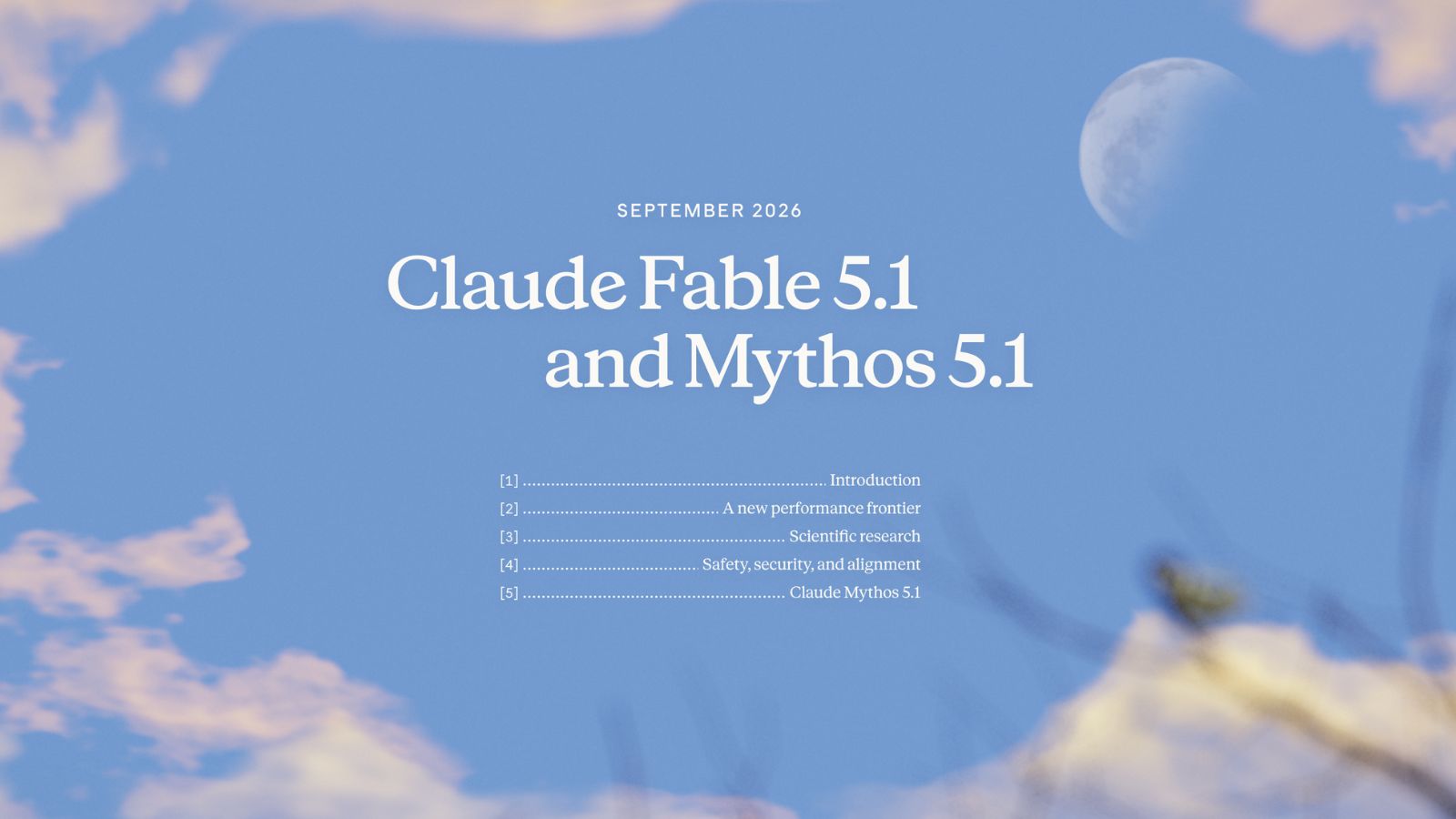
Anthropic, a frontier AI lab, has unveiled two new artificial intelligence models, Claude Fable 5.1 and Claude Mythos 5.1. According to the company, Fable 5.1 is designed to enhance coding, knowledge work, and research, while Mythos 5.1 is tailored for cybersecurity and biology. The two models share a common underlying system but differ in their safety measures.
Fable 5.1 is available to all, while Mythos 5.1 is currently accessible only to a select group of users and organizations in domains like cybersecurity and life sciences.
Anthropic claims that Fable 5.1 outperforms its predecessor, Fable 5, particularly in complex, long-running tasks, and is more cost-effective too. Workloads using Fable 5.1 could be up to 45 percent cheaper than those using Fable 5 due to reduced cache read costs, which now stand at $0.25 per million tokens, down from $1 per million tokens. Regular input and output costs remain at $10 and $50 per million tokens respectively.
In terms of performance, Fable 5.1 has shown remarkable results. It achieved a 52.6 percent score on the Terminal-Bench-Science benchmark, compared to 24.7 percent for Fable 5 and 29 percent for Opus 5. On the CursorBench, which measures agentic coding capabilities, Fable 5.1 scored 73.4 percent, outperforming both Fable 5 (70.5 percent) and Opus 5 (70 percent).
The new model has also demonstrated its potential in real-world problem-solving. For instance, it helped Millennium, an investment firm, trace a mysterious software crash to a bug in an external vendor library.
Another key focus of the new models is scientific research. Mythos 5.1 has designed high-affinity protein binders, with 50 percent of its designs confirmed viable in testing, compared to the typical hit rates of 10-15 percent in protein design. Moreover, Fable 5.1 has been used to create a higher-resolution elevation map of Venus, using data from NASA's Magellan mission. This map can reveal details at about two to three kilometers, compared to the earlier map's 10 to 20 kilometers resolution.
Anthropic has also strengthened the safety systems of their AI models. The updated cybersecurity safeguards have resulted in 60 percent fewer interventions per session for Claude Code users compared to previous versions. Additionally, Mythos 5.1, available through Anthropic's trusted access programs, can identify software vulnerabilities for defensive security work.
However, certain activities like exploit generation and penetration testing are still limited. In the future, Anthropic plans to expand the availability of these models.
Written by urgent.news from The Indian Express's reporting — not their text. Machine-written — may contain errors; check the original before relying on it.