User-Friendly Interface for Trace Element Open-System Melting Model
A 2001 model predicts trace element distributions in melts and residues of open-system mantle melting and melt migration. New software lets anyone apply this model despite its complex equations.
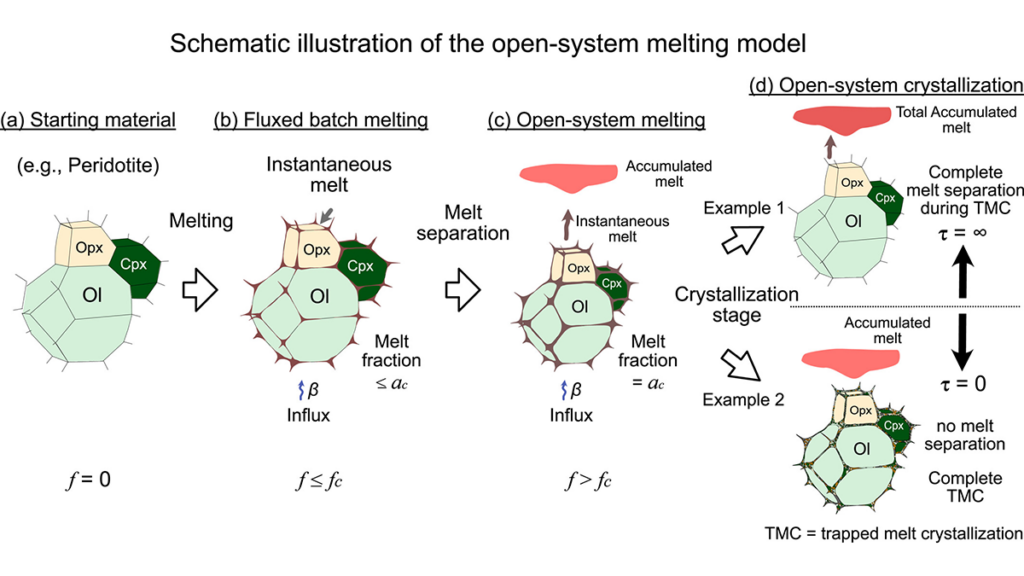
In the late 1980s, scientists discovered that the mantle's partial melting can generate a web of interconnected spaces, enabling the flow of molten material under low degrees of melting. This finding contradicted the earlier batch melting theory that had been the dominant view in mantle melting research. Trace element concentrations in erupted basalts and residual mantle peridotites provide crucial clues and constraints for understanding open-system melting processes.
Researchers have developed various analytical frameworks to study these patterns, with Ozawa's model, introduced in 2001, proving to be particularly effective. However, the complexity of Ozawa's equations made it difficult for geologists and petrologists to apply the model to new settings or datasets, requiring significant programming effort.
Nishio et al. have recently developed a new, user-friendly graphical user interface (GUI) that simplifies the application of Ozawa's model. This new tool allows even those with limited programming experience to confidently use the model and quickly visualize the effects of different parameters, choices, and data fit quality. With the ever-growing public databases of analytical results from basalts and mantle rocks worldwide, there are more chances than ever to examine the diverse melting environments found in Earth's varied tectonic settings.
An accessible tool for transforming raw data into valuable insights about these processes could greatly assist in realizing the potential of this research.
Written by urgent.news from Eos's reporting — not their text. Machine-written — may contain errors; check the original before relying on it.