Spain’s White-Headed Ducks Have a Signature Color Right in the Name. And That Isn’t Even Their Most Remarkable Hue
The first thing you’re likely to notice is the blue bill. But beyond appearances, the duck has an exciting story to tell about conservation and recovery
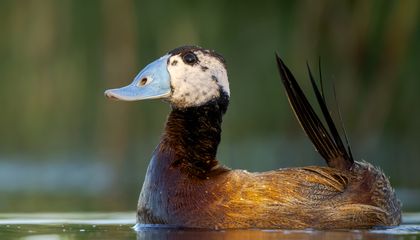
White-headed ducks boast a distinctive sky-blue bill that catches the eye during their dazzling springtime courtship displays. These otherwise unremarkable birds, found in Europe, North Africa, the Middle East, and Central Asia, perform intricate dances that include sideways swimming, exuberant splashing, and bill-beating to create bubble trails. Their long, stiff tail feathers play a key role in the show, waving, spreading, and slapping the water like paddles.
In Spain, white-headed ducks have experienced a remarkable conservation success story. Decades of wetland draining and habitat loss led to the species' near extinction in the 1970s, with only 22 individuals remaining in Spain. However, a national campaign that focused on wetland restoration, improved water management, and a ban on hunting has helped the population rebound to around 2,500 today and spread across the country.
While the situation is more grim elsewhere, with global white-headed duck numbers continuing to decline and the species listed as endangered on the IUCN Red List. The aggressive ruddy duck, an invasive American species, poses a significant threat to white-headed duck populations by outcompeting native males for mates and producing fertile hybrids. Efforts to control ruddy duck populations in Western Europe have helped, but the risk of a recurrence remains.
To further protect the species, a new multinational initiative has been launched this fall in southeastern Europe, the eastern Mediterranean, and Central Asia. The article's author cautions that describing the white-headed duck as a conservation success story requires a critical caveat – the story is not yet finished. Climate change and increasing droughts worldwide threaten wetlands, which are essential to the survival of these unique birds.
Written by urgent.news from Smithsonian's reporting — not their text. Machine-written — may contain errors; check the original before relying on it.