Simulations Show That Dark Matter Isn't What Gives Stellar Streams Their Kinks
Astronomers study dark matter through simulations of stellar streams around the Milky Way. They found that kinks and clumps within these streams aren't caused by dark matter clusters within the galactic halo.
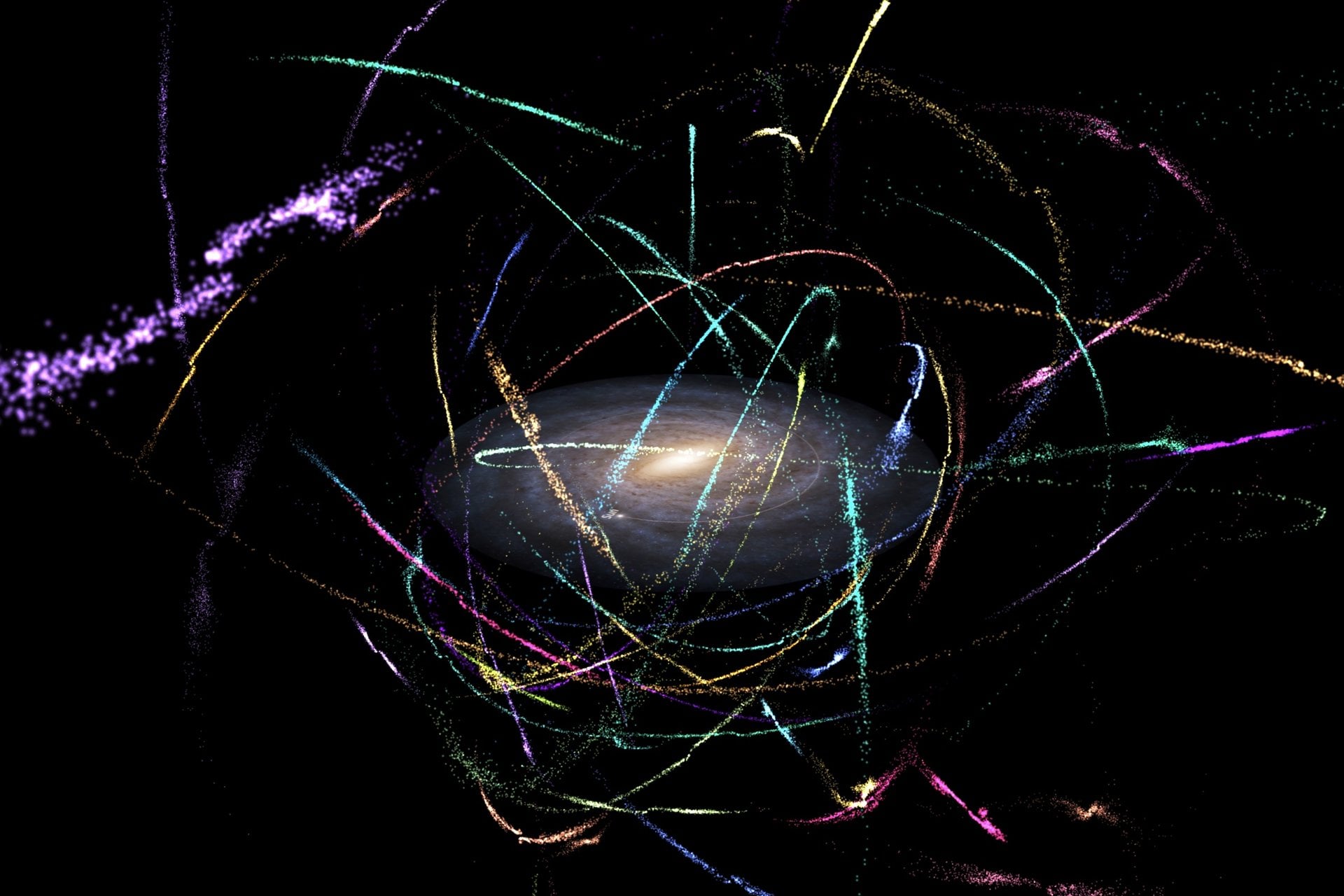
A new study published in The Astrophysical Journal explores how dark matter isn't the primary factor in shaping the kinks and twists found within stellar streams. Previous simulations typically examined large-scale cosmic structures, focusing on dark matter's influence on galaxy clustering. However, this study delves into stellar streams—chains of stars orbiting our Milky Way galaxy—rather than galaxy clusters.
Stellar streams are formed when dwarf galaxies or star clusters collide with larger galaxies, causing stars to scatter in streams that eventually orbit the dominant galaxy. Our Milky Way is known to possess at least two dozen such streams. The new research simulated the behavior of these stellar streams around galaxies similar to the Milky Way, treating dark matter as a uniform, simplified halo rather than incorporating its detailed properties.
The surprising finding was that regular matter, not dark matter, plays a significant role in creating the kinks and twists within these stellar streams. Dark matter, previously thought to be responsible for these deformations, doesn't appear to be a necessary factor. The kinking effect was found to be most pronounced in streams orbiting closer to the galactic center, but even more distant streams exhibit deformations. Streams that remain smooth are relatively rare.
Interestingly, many of the simulated streams mirrored the features observed in actual streams around the Milky Way, including the same twists, kinks, and clumps. This suggests that the large-scale features within these Milky Way streams are unlikely to be used to study dark matter clumping in our galaxy. However, the study hints at potential future insights.
Upcoming observations from the Vera Rubin telescope will provide detailed data on faint streams on the periphery of the Milky Way. If these observations reveal strong deformation effects, it could indicate the influence of dark matter interactions.
The study establishes valuable baselines for comparison between simulations and real-world observations. As with many such studies, more observational data will be crucial in determining where simulation and reality diverge.
Written by urgent.news from Universe Today's reporting — not their text. Machine-written — may contain errors; check the original before relying on it.