Scientists discover enormous 10-sided wave over Saturn
Scientists find a huge 10-sided wave pattern swirling in the clouds over Saturn's south pole
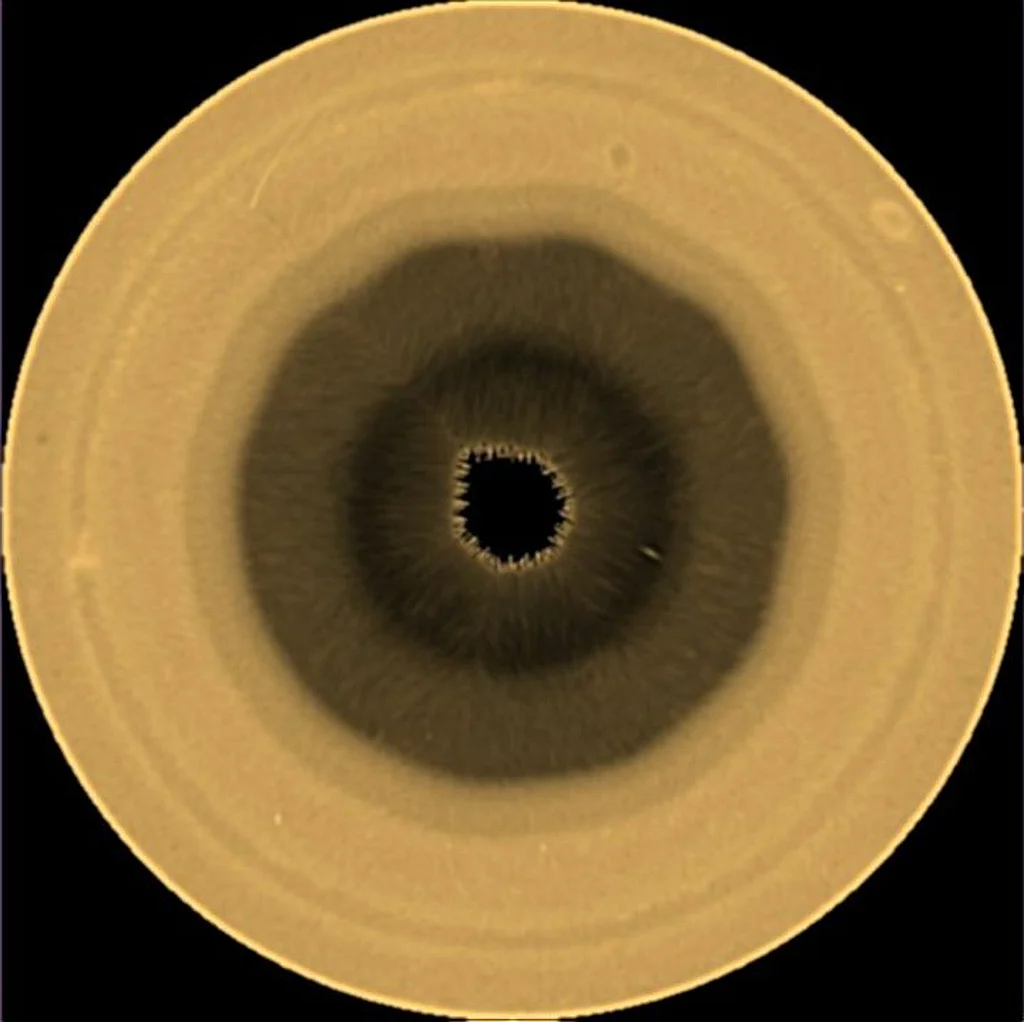
Scientists have discovered a massive 10-sided wave formation in the icy ammonia clouds above Saturn's southern pole. This spinning, irregular decagon is significantly larger and more unstable than the hexagonal cloud pattern observed at Saturn's northern pole by NASA's Voyager spacecraft in the 1980s, according to a Spanish-led team of researchers.
The decagon was first detected in 2023 by the Hubble Space Telescope, following previous attempts to spot it without success. Researchers believe the atmospheric phenomenon may have formed between 2017 and 2023, when the planet's south pole was tilted away from Earth and thus out of view. The decagon could still be evolving, with one side already spanning 16,700 kilometers.
The findings suggest that while the hexagonal feature is not as unique as previously thought, Saturn's ability to generate polygonal atmospheric patterns remains a mystery. Lead author Agustin Sanchez-Lavega from the University of the Basque Country noted that Saturn is the only planet in the solar system with wave-spawning disturbances that appear as geometric shapes.
The decagon moves eastward at a leisurely pace of 6 mph (10 kph), unlike the stationary hexagon. By comparing these two formations, scientists can gain insights into the weather patterns of giant gas planets. The researchers are curious about whether the decagon and the hexagon may be connected to Jupiter's cyclones, which also exhibit polygonal shapes.
Further observations of Saturn's southern hemisphere over the next few years may help unravel the enigma surrounding this intriguing atmospheric phenomenon.
Written by urgent.news from Gulf News's reporting — not their text. Machine-written — may contain errors; check the original before relying on it.
Also reported by 2 other outlets
- NASA scientists discover a giant 10-sided pattern on Saturn sciencedaily.com
- Astronomers discover unusual 10-sided atmospheric wave on Saturn physicsworld.com