Remnants of the Rattanakosin Walls in Khwaeng Wat Bowon Niwet, Thailand
The notion of historical "eras" often varies between cultures. Monarchies and empires often name eras after rulers, with Victorian and Georgian being examples from the English-speaking world. Even as one of the most important pop acts of the 21st century, Taylor Swift had her own take on "Eras". Thai culture often does timekeeping in its own way. Their numbering of years follows Buddhist…
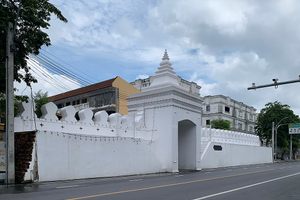
The concept of time periods varies across cultures. Monarchies and empires often name eras after ruling figures, as seen in English-speaking countries with Victorian and Georgian eras. Taylor Swift, one of the most prominent musicians of the 21st century, also followed this trend with her "Eras" album. Thai culture keeps track of time differently, using Buddhist benchmarks instead of the BC/AD system originating from Christianity.
Unlike many monarchies, the sequence of Thai historical periods is based on the city serving as the capital at that time, such as the Ayutthaya Era from 1351 to 1757, followed by the Thonburi Era (1767-82) and the Rattanakosin Era, which ended in 1932. The Thonburi Era was established on the west bank of the Chao Phraya River, while Rattanakosin was founded on an island on the east bank, both now part of Bangkok, the country's present capital and historical center.
Bangkok's strategic location near the river's mouth into the Gulf of Thailand has long necessitated some form of defense. During the Thonburi period, Rattanakosin Island began to be heavily fortified. Interestingly, given Bangkok's proximity to the crucial river mouth, its islands have had various defensive structures since the Ayutthaya Era.
However, today, only a few remnants of these defenses remain. The removal of the Rattanakosin Era walls occurred towards the end of the era itself. While the current era hasn't been officially named yet, it's likely to be the Bangkok Era (or Krung Thep Era, using the city's Thai short form). The expansion of Bangkok to include both Thonburi and Rattanakosin rendered the defenses obsolete.
Considering the relative peace in Thailand since the era's end, advancements in weaponry that can easily overcome walls, and impending urban sprawl, most of the walls and other defenses were taken down. Now, only a few remnants of these historical fortifications exist.
Written by urgent.news from Atlas Obscura's reporting — not their text. Machine-written — may contain errors; check the original before relying on it.