On this day in space! Sept. 2, 2016: Rosetta spacecraft finds long-lost Philae lander on Comet 67P after 2-year search
On Sept. 2, 2016, the European Space Agency finally located Philae, its long-lost comet lander on the surface of the Comet 67P. Here's why it mattered.
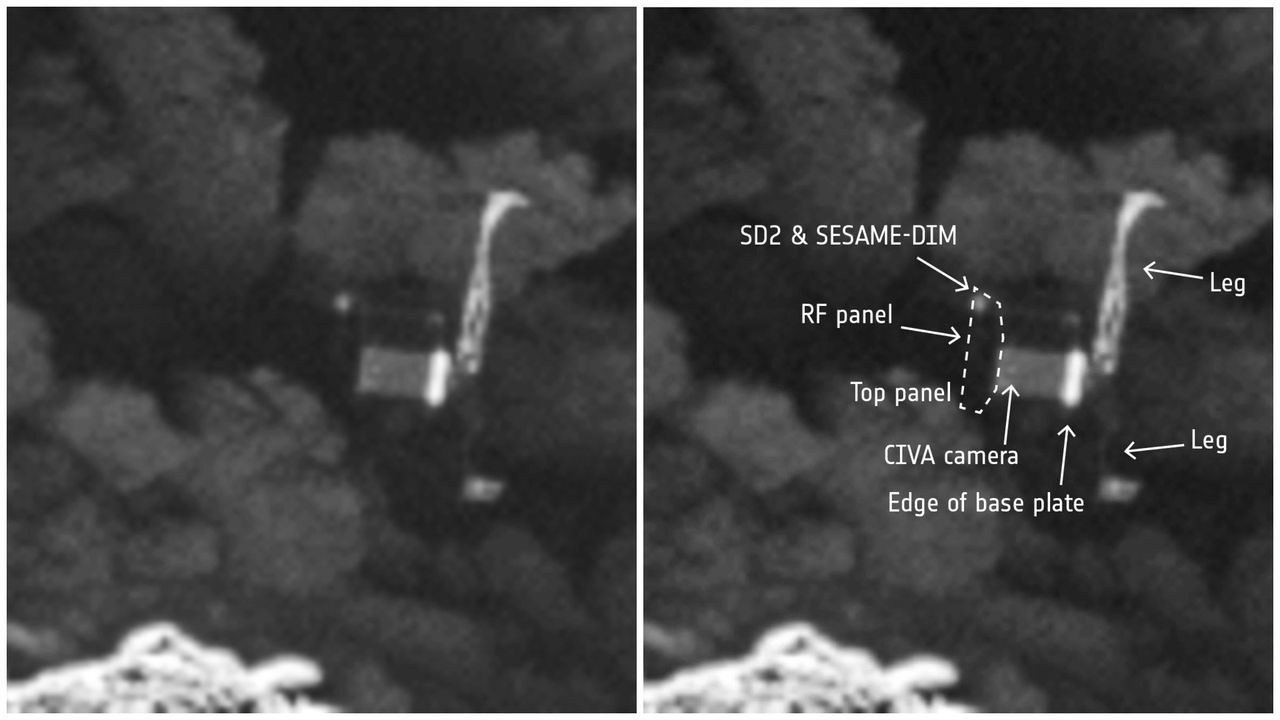
On September 2, 2016, the European Space Agency (ESA) successfully located the Philae lander, which had been missing for nearly two years. The Philae lander was a compact spacecraft, roughly the size of a washing machine, that was released by the Rosetta spacecraft onto Comet 67P/Churyumov-Gerasimenko in November 2014. Unfortunately, the lander's landing harpoons did not deploy correctly, causing the spacecraft to bounce around the comet before settling into a shadowy, rocky crevice where its solar panels could not efficiently collect sunlight.
Despite this unfortunate landing, Philae did manage to transmit some data to Rosetta using the remaining power from its batteries following the landing, and it managed to make intermittent contact for several months afterwards. Scientists and engineers at the ESA continuously monitored Rosetta's position as it orbited the comet, using its cameras to search for the lost Philae lander.
It took nearly two years for the Rosetta team to finally spot Philae on September 2, 2016. After analyzing images taken by Rosetta, they discovered that Philae was lying on its side within a dark crevasse on the comet's surface. The discovery provided the European Space Agency with a sense of closure, just days before the mission's end with Rosetta's own crash landing on Comet 67P on September 30, 2016.
The Rosetta mission was a groundbreaking endeavor, marking the first successful soft landing on a comet to study the icy bodies and their behavior within the solar system. Although the Philae lander's mission was cut short due to its failure to anchor into the comet's surface, it still managed to make several key discoveries, including the detection of organic compounds on the comet.
Written by urgent.news from Space.com's reporting — not their text. Machine-written — may contain errors; check the original before relying on it.


