How the SCO chips away at US power without an alliance system
The Shanghai Cooperation Organisation (SCO) was born 25 years ago as a modest mechanism for managing borders between China, Russia and four Central Asian states. At its anniversary summit in Bishkek this week, it looks more consequential – and harder for the United States to dismiss. The timing is important. Russia’s invasion of Ukraine remains unresolved, while the war between Iran and the US…
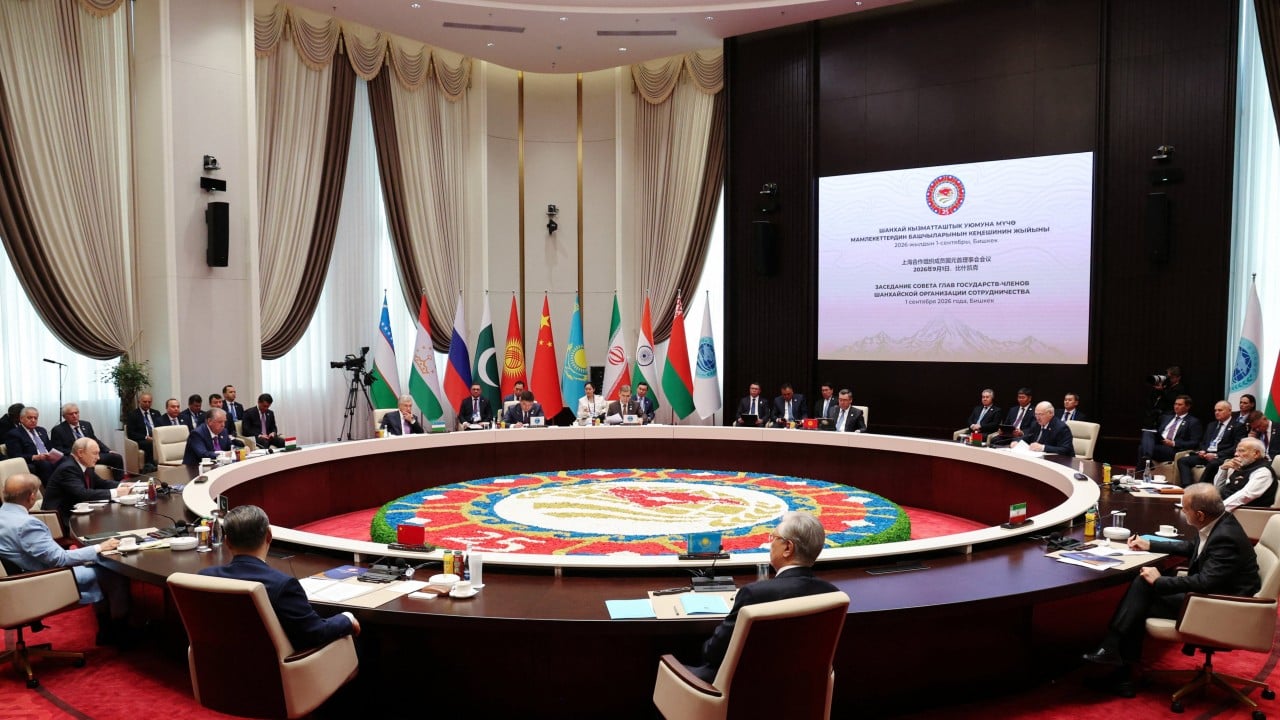
The Shanghai Cooperation Organisation (SCO) was established 25 years ago as a simple arrangement for managing borders between China, Russia, and four Central Asian states. This week, at its anniversary summit in Bishkek, the SCO has become a far more influential entity that challenges the United States' global dominance. This is especially pertinent, as Russia's ongoing invasion of Ukraine and the conflict between Iran and the US have transformed the Persian Gulf into another battleground for strategic competition, with energy markets now exposed to potential disruptions in the Strait of Hormuz.
The SCO now includes China, Russia, India, Iran, Pakistan, most of the Central Asian republics, Belarus, Turkey, and various Gulf states, bringing together over 3.4 billion people and around a quarter of the world's GDP. Its growing importance is not merely due to its size, but to President Xi Jinping's vision of the SCO assuming a larger role in technology and security.
He envisions it as a forum that fosters cooperation, security, well-being, and dialogue among its members, without engaging in formal alliances or targeting third parties. The SCO's significance lies in its practical value for states that wish to avoid having their foreign policies dictated by the United States.
Rather than posing a direct challenge to the US, the SCO serves as an alternative model of international organization that allows countries to coordinate, negotiate, and hedge their interests. It does not possess Nato's military command or the EU's supranational institutions, but it offers a space for states that do not want their foreign policy influenced by Washington to come together.
The SCO's agenda has broadened beyond its original focus on security, encompassing trade, energy, transport, technology, and finance, alongside counterterrorism and regional security. Technology, in particular, is emerging as a key focus for the SCO, reflecting a broader shift in the sources of geopolitical power. Xi Jinping emphasizes the SCO's role in technology and security, reflecting how digital infrastructure, artificial intelligence, data, and technology standards are increasingly shaping national security alongside conventional military capabilities.
The SCO members have also discussed using national currencies, financial cooperation, and new development mechanisms, including an SCO development bank. While these efforts do not pose an immediate threat to the US dollar's central position, they indicate a growing trend towards alternative channels for trade and payments, spurred by Western sanctions and restrictions on access to financial infrastructure.
The SCO's expansion is driven by the geographic and economic realities that have highlighted the vulnerability of China to maritime chokepoints and the strategic value of continental energy supplies. China remains a significant purchaser of Russian crude, and the war in Ukraine has underscored the importance of diverse energy routes and the potential risks associated with relying on a single supplier.
In this context, the SCO provides China with a platform to expand its economic connectivity and political influence without being obligated to provide security guarantees to every member. While Washington should take the SCO seriously, it should avoid pursuing a strategy that relies heavily on tariffs, technology restrictions, and pressure on third countries to choose sides.
Such tactics can inadvertently encourage the kind of strategic hedging that makes institutions like the SCO more valuable. Instead, the US should distinguish between adversaries and institutions, recognizing that economic pressure can both be beneficial and encourage countries to seek alternative suppliers, markets, technologies, and payment systems.
Washington must also recognize the potential value of engaging with the SCO's members where interests align, such as in Central Asia, India, and Turkey. At the same time, the US should compete with China without viewing every Chinese initiative as hostile, protect its technological advantages without accelerating the development of parallel systems, and maintain open diplomatic contacts with governments whose cooperation could become crucial on issues such as energy, terrorism, proliferation, and conflict.
The SCO's 25th anniversary highlights that Eurasian states are creating cooperation mechanisms that can withstand internal disagreements. While Washington cannot prevent this evolution, it must decide how to respond. This could involve working with Central Asian states where interests overlap, maintaining strong channels with India and Turkey, competing with China without treating every Chinese move as hostile, safeguarding technological advantages without fostering alternative systems, and keeping diplomatic contacts open with governments whose cooperation may become important in areas such as energy, terrorism, proliferation, and conflict.
The SCO is unlikely to become a Eurasian version of Nato; its importance lies in its contribution to a more fragmented international system where power is more widely distributed and middle powers have more options. The question for Washington is whether it is prepared for a world in which it is no longer the central figure around which every major geopolitical discussion must revolve.
Written by urgent.news from Reuters Business via SCMP's reporting — not their text. Machine-written — may contain errors; check the original before relying on it.
This story
This is one outlet's version. Read the fullest account.