GitOps in 2026: Why Pull Requests Are Taking Over Cloud Operations
For years, cloud infrastructure changes were mostly a mystery. An engineer would log into a dashboard, tweak a setting, run a few scripts, and that was it. Nobody worried until something broke. Suddenly, everyone wanted answers. Who changed this? Was it tested? Can we fix it? How did production end up out of sync with […]
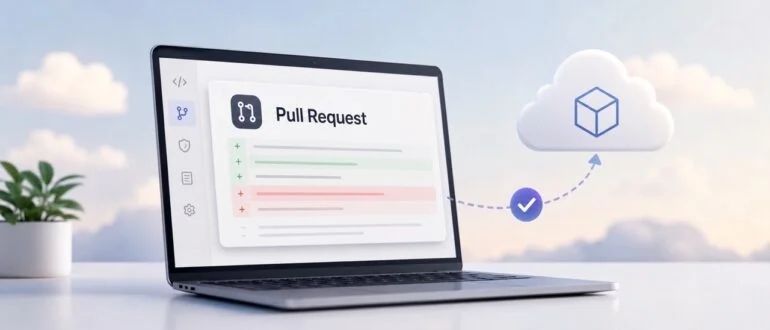
In 2026, pull requests are becoming the dominant method for managing cloud operations, replacing the traditional approach of manual dashboard adjustments. This shift is driven by the complexity of modern cloud infrastructures, which comprise multiple components such as Kubernetes clusters, cloud services, databases, networking, app configurations, and security policies spread across various environments.
Manual changes prove to be inefficient and unscalable in such a dynamic environment. Enter GitOps, a methodology that treats Git as the single source of truth for infrastructure, and utilizes pull requests for change management, complete with reviews, automated checks, and approvals. By 2026, this process extends beyond Kubernetes deployments, evolving into the primary control hub for cloud operations.
Traditional cloud management revolved around manual actions such as server spinning, network rule modifications, and capacity adjustments. With GitOps, the emphasis transitions to declaring the desired state. For instance, if a higher number of replicas is required for a deployment, the necessary configuration is updated in Git.
This change is then encapsulated in a pull request, which undergoes review, automated testing, and, upon approval, results in the environment being updated by controllers. This subtle yet significant change in approach offers numerous benefits. The Git repository records intentions, facilitating discussions through pull requests and enabling rollbacks through simple restoration of prior configurations.
Infrastructure is transformed from a combination of ad-hoc dashboard edits and forgotten shell commands into a transparent, traceable, and simplified management process.
Pull requests, originally a tool for developers to review and merge code changes, are now integral to operational workflows in GitOps. From updating cloud policies to modifying Kubernetes configurations, access controls, and infrastructure definitions, all changes are managed via pull requests. This unifies the operational process for both development and operations teams.
The common language of proposing, reviewing, testing, approving, merging, and applying changes fosters collaboration and clarity. Importantly, GitOps setups automate routine checks, allowing engineers to concentrate on high-priority tasks. Rather than being a means of gatekeeping, GitOps enhances transparency and repeatability in changes.
GitOps originated from its seamless integration with Kubernetes, an orchestration platform that manages desired state configurations. Kubernetes tools compare desired and actual states, reconfiguring the environment to match the declared state if discrepancies arise. Unlike conventional CI/CD pipelines, GitOps continuously monitors for drift - the divergence between the declared state in Git and the actual state in production.
With the ever-changing nature of cloud environments prone to manual tweaks, failures, and drift, GitOps establishes a feedback loop between intended changes and actual execution.
Config drift, where production settings deviate from the documented state, poses a significant challenge. While GitOps does not prevent manual changes, it makes drift evident and manageable. By comparing declared configurations in Git with live state, it flags out-of-band changes, enhancing visibility and simplifying corrective actions.
This transparency is invaluable when production deviates from the intended state. With GitOps, organizations gain a clear understanding of what changed, who approved it, when the change was implemented, and the previous configuration, thereby facilitating effective incident response.
Policy checks have become an integral part of the pull request process in GitOps. Infrastructure updates undergo validation against Terraform configurations, Kubernetes manifests, security policies, resource limits, and compliance requirements before being deployed to production. This proactive approach ensures that potential issues are identified early, reducing the likelihood of unexpected problems.
Teams enforce these rules through automated checks, mitigating the need for extensive documentation that may go unnoticed. Some may perceive GitOps as requiring manual sign-offs for every change, which can be impractical in high-velocity environments. However, automation remains crucial. Teams implement risk-based rules, automating low-risk changes and requiring human review for more critical modifications.
Written by urgent.news from DevOps.com's reporting — not their text. Machine-written — may contain errors; check the original before relying on it.