Enflame’s US$900m IPO tests appetite for China’s ‘little dragon’ AI chipmakers
As Enflame Technology gears up for a 6.12 billion yuan (US$910.3 million) initial public offering on Shanghai’s Star Market, the Chinese artificial intelligence chipmaker must convince investors that its specialised chip strategy can withstand fierce competition from Huawei Technologies and other domestic rivals, while reducing its heavy revenue dependence on major backer Tencent Holdings. Online…
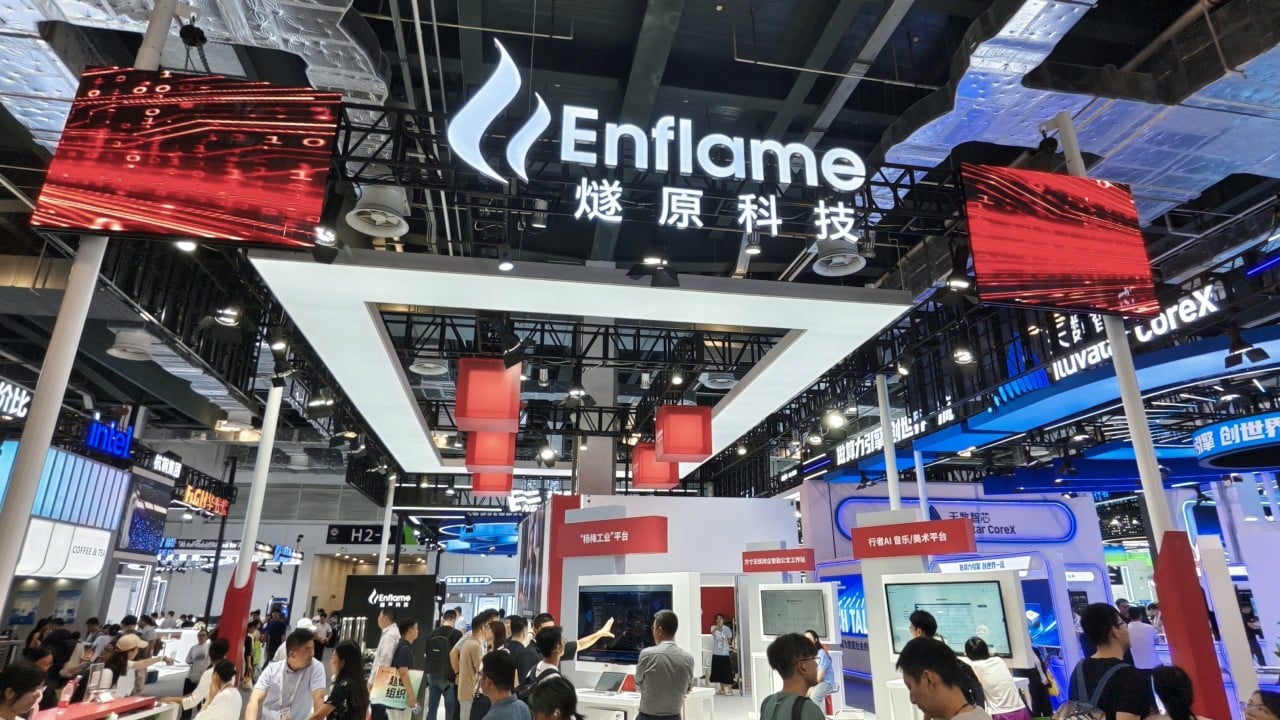
Enflame Technology, a Chinese artificial intelligence (AI) chipmaker, is set to launch its IPO on Shanghai’s Star Market with an offering of 6.12 billion yuan, or approximately US$910.3 million. This IPO comes amid a significant fundraising wave by China's "four little dragons" of AI chips – Enflame, Moore Threads, Biren Technology, and MetaX Integrated Circuits.
The company aims to persuade investors that its specialised chip strategy can withstand fierce competition from established players like Huawei Technologies and reduce its revenue dependence on major backer Tencent Holdings.
Enflame plans to issue 43.04 million shares at 142.18 yuan (US$21.15) each, with the IPO debut marking the culmination of a historic public fundraising period for China's AI chip sector. The "four little dragons" have raced to scale production amid export curbs by the United States on advanced Nvidia hardware, spurred by Beijing's push for technological self-sufficiency and AI infrastructure development.
However, Enflime faces distinct strategic hurdles. Unlike its competitors, which focus on general-purpose graphics processing units (GPUs), Enflame has chosen to develop domain-specific architecture (DSA) chips. These chips are designed to maximise computing efficiency for targeted tasks such as AI inference. While DSA chips are expected to capture significant market share in standardised enterprise and internet inference tasks, their more limited flexibility could create bottlenecks during rapid AI model iterations, potentially giving an edge to GPUs compatible with Nvidia's software ecosystem in mixed-workload markets.
Moreover, Enflime's heavy revenue dependence on Tencent Holdings could be a major vulnerability. Tencent, the company's largest shareholder with a 20% stake, also represents its primary revenue anchor, with Enflime's sales to the social media and gaming giant accounting for 33% of revenue in 2023 and 38% in 2024, surging to 84% in 2025. This concentration risk highlights the challenge Enflime faces in diversifying its client base beyond Tencent.
To address this concentration risk, Enflime's prospectus states that Tencent's demand for AI accelerator cards currently exceeds the chipmaker's supply capacity. The company plans to gradually expand into broader enterprise markets to mitigate this risk. However, execution could depend heavily on navigating supply chain constraints.
Jimmy Yu, head of China technology research at UBS Securities, noted that securing foundry capacity and component supplies, such as high-bandwidth memory, capacitors, and printed circuit boards, remains critical for Enflime's success in the domestic semiconductor landscape.
Written by urgent.news from SCMP Tech's reporting — not their text. Machine-written — may contain errors; check the original before relying on it.
This story
This is one outlet's version. Read the fullest account.