Distant Quasars Provide Crucial Link In Understanding Earliest Supermassive Black Holes
Extreme quasars near the dawn of time are giving astrophysicists clues to the formation of supermassive black holes.
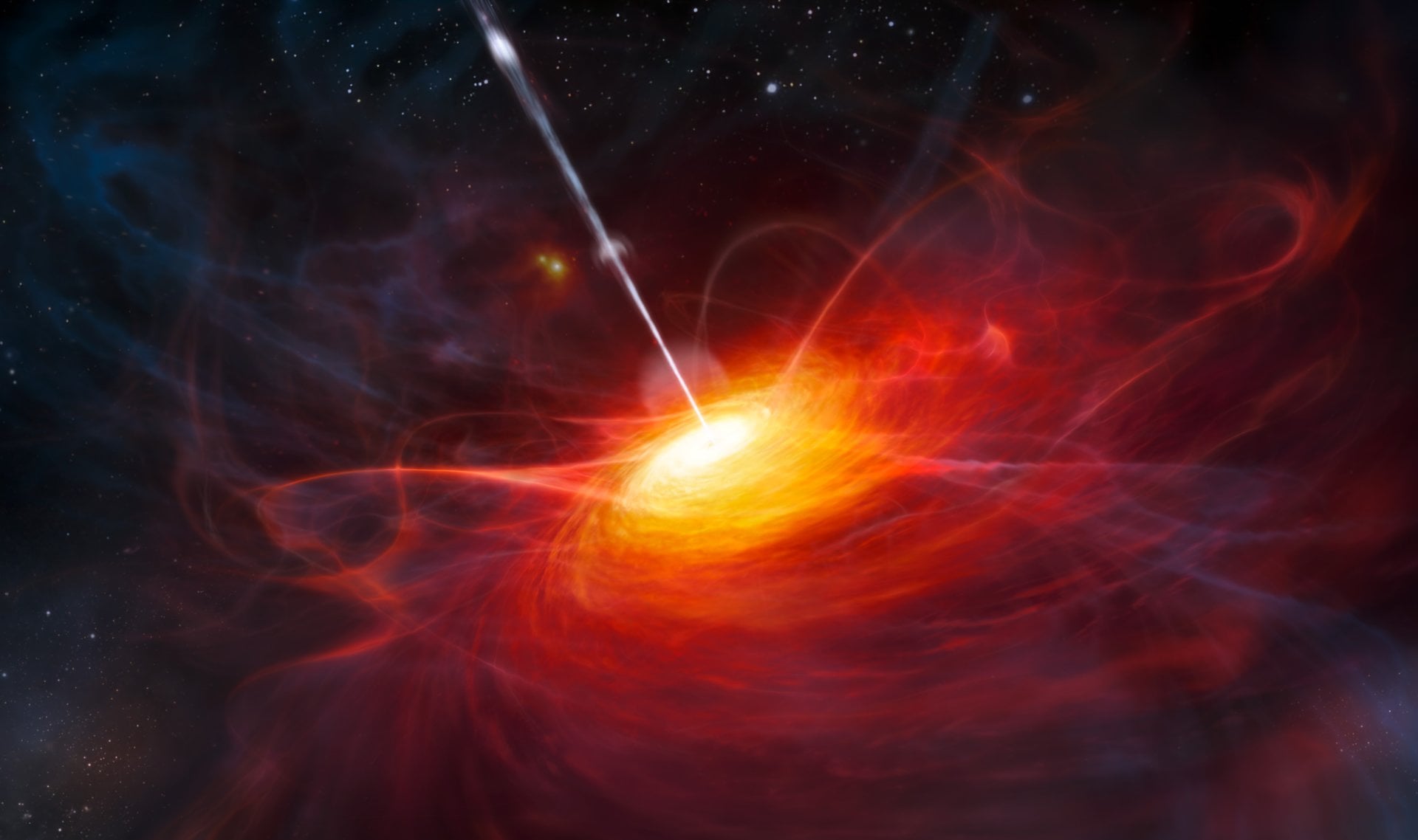
Distant quasars have provided crucial insights into the formation of supermassive black holes that reside at the heart of most large galaxies, including the Milky Way. These massive black holes can have masses ranging from a million to over a billion times that of the Sun. Daniel Mortlock, an astrophysicist from Imperial College London, explained that these black holes grow by accreting material, which heats up, glows, and outshines all the stars in the galaxy, creating a quasar.
A recent study published in Astronomy & Astrophysics (A&A) revealed two of the most distant quasars ever observed, detected during the first year and a half of the European Space Agency’s Euclid Space Telescope's wide-angle survey. The authors noted that these quasars were found within 3000 square degrees of sky covered, and their spectroscopic follow-up observations were carried out using the Keck, Magellan, and Large Binocular Telescope observatories.
Quasars, although not currently considered as exciting as they once were, are essential to understanding how supermassive black holes helped spawn massive spiral galaxies throughout cosmic time. The authors of the A&A paper highlighted that understanding these early quasars would be key to unraveling the mechanisms that allowed these black holes to form so rapidly, even when the universe was only 650 million years old.
The detection of these quasars involves identifying an object that is bright in the infrared but absent in the optical spectrum, as the universe's expansion has redshifted their light from the ultraviolet to the infrared. The study of quasars has evolved significantly since their initial discovery in the radio spectrum by a group of astronomers at Cambridge University in the 1950s.
Donald Lynden-Bell, a former director of Cambridge University's Institute of Astronomy, proposed that most large galaxies, including the Milky Way, could host a dormant quasar in their nucleus.
Written by urgent.news from Universe Today's reporting — not their text. Machine-written — may contain errors; check the original before relying on it.