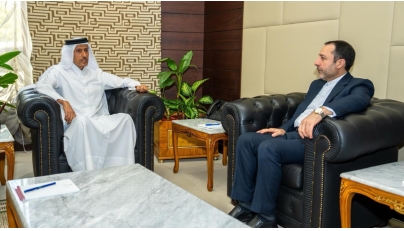
Chairman of Qatar Media Corporation holds talks with Iran's Ambassador
<p>Doha, Qatar: Chairman of the Qatar Media Corporation HE Sheikh Hamad bin Thamer Al-Thani held talks with Ambassador of the Islamic Republic of Iran to the State of Qatar HE Ali Salehabadi. The talks took place in Doha on Wednesday and focused on media relations and cooperation between Qatar and Iran.</p>
Indian Prime Minister Narendra Modi's recent dialogues with Russian President Vladimir Putin and Iranian leader Masoud Pezeshkian at the Shanghai Cooperation Organisation (SCO) summit have highlighted his potential as a mediator in major conflicts. As a nation situated between Russia and the West, and maintaining connections with rival factions in the Middle East, India is perceived by some analysts as a potential bridge between conflicting parties. However, experts caution that access does not automatically equate to influence.
During the summit in Bishkek, Kyrgyzstan, Modi called upon Putin to terminate the conflict in Ukraine, emphasizing that each day of warfare erodes global harmony. "India stands in solidarity with all peace initiatives and pledges to maintain its support for such endeavours," Modi stated. Iran, for its part, solicited Modi's assistance in leveraging India's extensive network to dissuade other parties from conflict.
"We firmly believe that the resolution to our challenges lies in dialogue and cooperation, and that all available capacities must be harnessed to avert the escalation of insecurity and discord," Pezeshkian conveyed.
These encounters underscored the role Modi might assume in alleviating conflicts where India has traditionally refrained from taking partisan stances while advocating for peace. Srinivasan Balakrishnan, director of strategic engagements and partnerships at the Indic Researchers Forum think tank, posited that Modi's appeals to Putin and Iran suggest Delhi is experimenting with a new role.
"India possesses a unique capacity to interact with Moscow, Tehran, and the West concurrently. This access is genuine, but transforming it into tangible resolutions proves challenging," Balakrishnan remarked. "India has the former, but must demonstrate the latter."
The SCO, comprising China, Russia, India, Pakistan, and Iran, adopted a joint declaration condemning military assaults on Tehran and endorsing a resolution adopted by all member states, including India. The statement did not single out Israel or the United States. India had previously distanced itself from an SCO statement in June 2021 that denounced Israeli military strikes on Iran.
Three months later, Modi endorsed the Tianjin declaration, which labeled the US strikes against Iran as violations of international law and the UN Charter. The latest statement, ahead of the upcoming Brics summit in Delhi, underscores the importance of diplomacy over aggression and indicates that conflict concerns will likely dominate the Brics gathering.
The resolution of international disputes is anticipated to be a prominent topic at the Brics summit, with Putin, Pezeshkian, Chinese President Xi Jinping, UN Secretary General Antonio Guterres, and other prominent leaders slated to attend. Balakrishnan asserted that India's chairmanship, which allows it to maintain communication with Moscow, Tehran, and the West, could prove invaluable in preventing the discourse from devolving into factional rhetoric.
This development could carry international ramifications, positioning Brics as an instrument promoting peace, stability, and economic assistance to a beleaguered world. However, Balakrishnan emphasized that whether this theme holds significance depends on India's ability to engage all parties without becoming an instrument of their influence.
Analysts argue that while Modi's encounters with Putin and Pezeshkian demonstrate that both leaders respect his political stature as a three-term Indian prime minister, resolving either conflict remains a formidable challenge. Modi is likely to encounter resistance from Russian leaders if he abruptly attempts to end the war, and persuading US President Donald Trump to terminate the Iran conflict, despite their friendship, would be equally arduous.
"While Modi may be well-liked, his political clout alone does not guarantee the ability to alter a nation's policies," Harsh Ramaswamy, an independent political commentator, contended.
Political scientist Uday Chandra from Ashoka University noted that while India's diplomatic relations with Washington, Moscow, Israel, and Iran have strengthened, it is premature to label Modi as a "new mediator in global disputes." "Changes in geopolitics confer new value on India's multilateral approach," Chandra stated. "The SCO and the forthcoming Brics summit will undoubtedly enhance India's multilateralism's visibility in world politics."
Written by urgent.news from South China Morning Post's reporting — not their text. Machine-written — may contain errors; check the original before relying on it.
This story
This is one outlet's version. Read the fullest account.