Art Exhibits at OAX Airport in San Juan Bautista la Raya, Mexico
The state of Oaxaca in Mexico's south is often considered one of the country's main artistic hubs. Its diversity in nature and indigenous cultures has created an atmosphere of inspiration for creative endavors. In the capital city of the same name, known fully as Oaxaca de Juárez , perhaps the clearest examples are its booming gastronomic and graphic arts scenes. While it seems that the first…
The state of Oaxaca, located in Mexico's southern region, is renowned as one of the country's primary artistic centers. Its diverse natural landscapes and indigenous cultures foster an environment conducive to creative endeavors. The capital city, Oaxaca de Juárez, boasts thriving gastronomic and graphic arts scenes. Air travel to the city commenced in 1922, but it wasn't until 1940 that an airport was constructed to accommodate it.
Named Aeropuerto Internacional de Xoxocotlán, the airport underwent significant renovations starting in 2019, a process that was delayed due to the COVID-19 pandemic. Notable Oaxacan artists who honed their skills in the 20th century include Rufino Tamayo, Rodolfo Morales, and Francisco Toledo, whose contributions primarily consist of murals, paintings, and prints.
The city is particularly acclaimed for its mural art and its reputation as the country's printmaking hub, making it a major platform for Oaxacan artists in the 21st century.
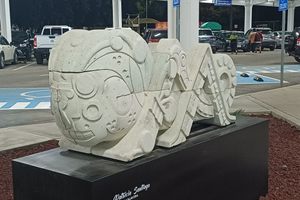
However, when it came to transforming the airport into a cultural hub, sculpture was chosen over graphic arts due to its monumental scale. It is believed that the art displays commenced in 2018, with exhibitions featuring the collective La Barda de Adobe and artist Manuel Miguel. Since then, the airport has hosted works by other Oaxaca-based artists, ranging from Alberto Aragón Reyes, whose sculptures are crafted from recycled materials, to Fernando Andriacci, known for his psychedelic, multicolored animal sculptures.
In 2024, Patricio Santiago was featured as the sculptor, creating pieces predominantly made from cantera stone, including the distinctive green-hued type that is emblematic of Oaxaca City.
Written by urgent.news from Atlas Obscura's reporting — not their text. Machine-written — may contain errors; check the original before relying on it.