AI dominates the 4th International Congress of Basic Science in Beijing
Subir Sarkar finds that AI was a hot topic among the over 800 delegates The post AI dominates the 4th International Congress of Basic Science in Beijing appeared first on Physics World .
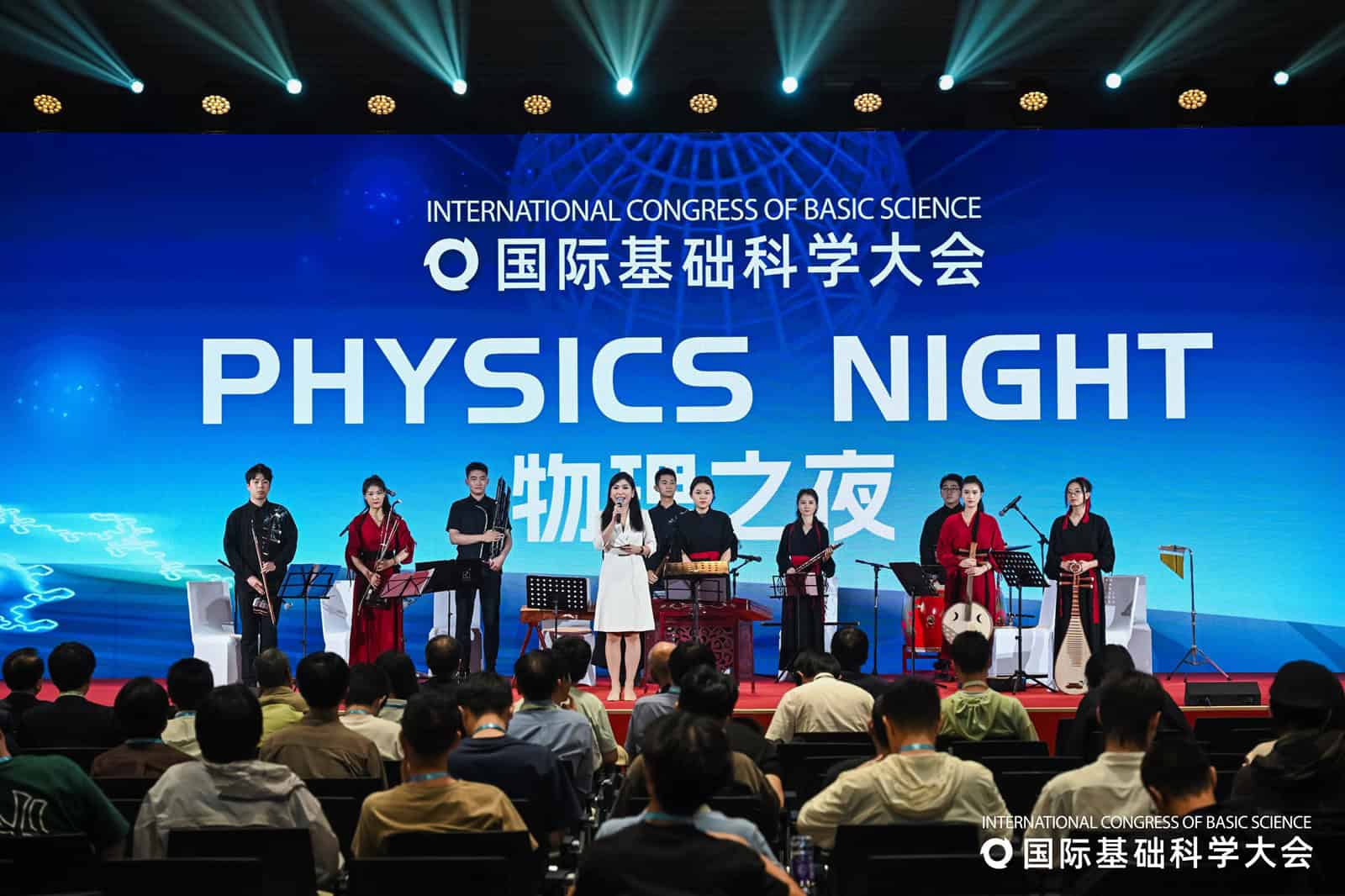
In 2026, China emerged as the leading nation in scientific research, surpassing all other countries according to a recent analysis by Nature. The country's dominance extends across all disciplines, with 51 of the world's top 100 institutions located in China, compared to only four in the UK. This strong performance was evident at the fourth International Congress of Basic Science (ICBS) held in Beijing from August 9-21, 2026.
The congress, founded in 2023 by Fields-medal-winning mathematician Shing-Tung Yau, attracted over 800 participants from more than 30 countries, with a total of 140 full-time researchers, 50 of whom were from outside China.
The congress featured over 500 academic sessions, covering a wide range of topics from generative AI reasoning to quantum information. Nine scientists, including four women, were awarded an inaugural Basic Science Medal, highlighting their outstanding contributions in their respective fields. These awardees represented various disciplines, underscoring China's growing international impact and vitality in basic science research.
In addition to the medal awards, the congress also presented Frontiers of Science Awards to over 500 researchers from 20 countries. These awards recognized researchers who had produced excellent and outstanding scholarly work over the past five to ten years in the three scientific fields represented at the ICBS. The event also featured student nights, plenary sessions, and special events for entrepreneurs, school, and university students, with a particular focus on engaging youth in mathematics, physics, and engineering.
However, the congress was not just a platform for scientists to share their research. It also addressed the growing role of artificial intelligence (AI) in scientific research. Fields medallist Martin Hairer, Caucher Birkar, and Robert Endre Tarjan shared their perspectives on the impact of AI on mathematics. Hairer suggested that AI would transform how mathematics is conducted, while Birkar noted that AI excels in computation and proof completion but struggles to generate original ideas.
Tarjan encouraged young researchers to be curious, committed, and independent in their pursuit of scientific discovery, emphasizing that AI can be a powerful tool when used appropriately.
ICBS chair Shing-Tung Yau concluded the congress by emphasizing that while AI will enhance scientific research, the essence of discovery will always depend on human creativity, imagination, and independent thinking.
Written by urgent.news from Physics World's reporting — not their text. Machine-written — may contain errors; check the original before relying on it.