56% of Consumers Have Faced a False Payment Decline
Merchants may have more revenue to gain from approving good customers than from tightening fraud controls another turn. That opportunity runs through “The Performance Gap: Why Every Transaction Is a Growth Opportunity,” the August edition of the “Optimizing Payments Tracker® Series.” The report finds that failed authorizations, processing costs and fraud controls can weaken payment […] The post…
A recent report highlights the potential for merchants to increase revenue by approving good customers instead of implementing stricter fraud controls. The August edition of the "Optimizing Payments Tracker® Series" reveals that failed authorizations, processing costs, and fraud controls can negatively impact payment performance.
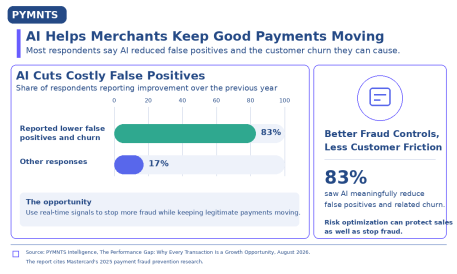
Newer payment platforms seek to address these issues by integrating authorization, cost, and risk tools into a single system. The report emphasizes the role of artificial intelligence in reducing false declines and their impact on customer churn. Eighty-three percent of surveyed merchants reported that AI significantly decreased false positives and related customer loss.
Artificial intelligence evaluates behavior, past transactions, and current signals to distinguish suspicious activity from genuine purchases more accurately. Risk controls can protect revenue while preventing losses. A PYMNTS Intelligence study found that 56% of U.S. consumers encountered a false payment decline within the last three months, and 42% abandoned their carts after a failed transaction.
For merchants, a legitimate transaction rejected by a cautious system can result in lost sales and weakened customer relationships. Implementing smarter screening methods can help alleviate both risks. Mastercard research indicates that 42% of issuers and 26% of acquirers had collectively blocked over $5 million in attempted fraud using AI-powered detection over the past two years.
This technology operates like an advanced airport security line, directing close scrutiny towards high-risk activities while allowing legitimate customers to proceed more swiftly. The report also explores optimization in authorization and cost reduction. Sixty-nine percent of companies utilizing core orchestration tools attain approval rates exceeding 97%, while only 32% of firms relying on manual routing achieve similar success.
Payment orchestration can also lower processing fees by up to 30%. The findings suggest that merchants can simultaneously enhance protection, lower costs, and improve checkout experiences through intelligent payment systems. These systems can simultaneously boost revenue from existing demand.
Written by urgent.news from PYMNTS's reporting — not their text. Machine-written — may contain errors; check the original before relying on it.