Was Abe Shinzo an Idealist?
A new biography of Japan's longest-serving prime minister reevaluates his realist legacy.
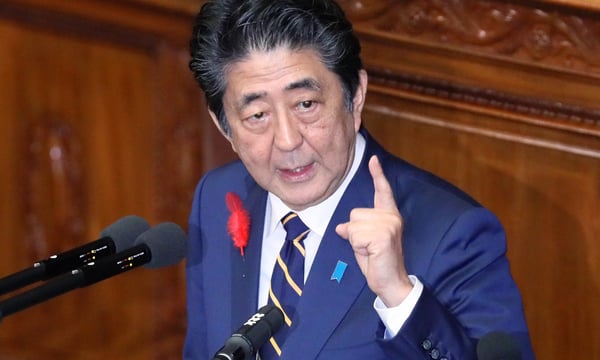
Japanese Prime Minister Abe Shinzo, who served for the longest tenure in history, has generated numerous biographies that tend to reflect partisan bias. While some portray him as a would-be dictator and others as a messianic figure, the most analytical accounts have praised his pragmatic and realistic foreign policy. However, until now, no comprehensive biography had been published due to Abe's sudden death.
Hattori Ryuji, a professor at Chuo University, has now released a detailed study that challenges the notion that Abe was merely a realist foreign policy thinker, arguing that he was in fact an imperfect realist.
Abe's most distinctive foreign policy idea was the "Free and Open Indo-Pacific," which emphasized Japan's interests in the world and encouraged other nations to adapt to a new era with heightened Indo-Pacific influence. This vision was reflected in Abe's promotion of free trade agreements, including the CPTPP, the Japan-EU Economic Partnership Agreement, and the RCEP negotiations.
However, while Abe's liberal international order aligns him closely with the West, his biases may have hindered his effectiveness in East Asian diplomacy.
Abe's willingness to engage with Russia and China sometimes resulted in Japan ceding valuable leverage, possibly due to misconceptions and biases that undermined the legitimacy of Japan's stance on disputed territories like the Senkaku Islands. His failure to achieve progress in relations with North Korea and South Korea, despite championing the cause of abducted Japanese citizens, further illustrates the imperfect nature of his realist approach.
Abe's determination to maintain firm positions on historical issues hindered his ability to compromise, exacerbating bilateral tensions with both South Korea and China.
Despite inheriting his grandfather's mission to revise the U.S. occupation's pacifist Constitution and fostering a strong alliance with the United States, Abe struggled to fully embrace the realist ideal. His historical perceptions, political legacy concerns, and personal sentiment prevented him from achieving a more balanced diplomatic strategy.
Thus, Abe's foreign policy might be better understood as idealist rather than realist, influenced by his emotional attachment to Japan's Western identity and his commitment to rectifying historical wrongs.
Written by urgent.news from The Diplomat's reporting — not their text. Machine-written — may contain errors; check the original before relying on it.