To Secure the Natuna Sea, Indonesia Needs More Than New Ships
Maritime security is one of Indonesia’s most demanding defense domains. And at its current stage, Indonesia needs significant help.
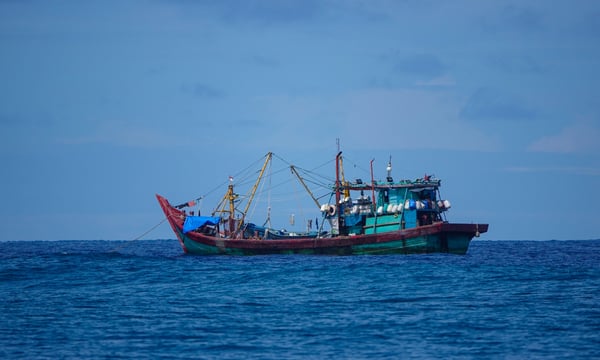
Indonesia faces significant challenges in securing its Natuna Sea due to illegal, unreported, and unregulated fishing, a common issue in Southeast Asia's maritime security. As the world's largest archipelagic nation, Indonesia's maritime security is a demanding aspect of its defense domain. The North Natuna Sea, which lies within Indonesia's exclusive economic zone (EEZ) and overlaps with China's South China Sea claims, is particularly vulnerable to commercial fishing activities.
Despite Indonesia's efforts, illegal activities persist. Since the 2019-2020 confrontations near the Natuna Islands, the government has expanded the Indonesian Navy and Maritime Security Agency (Bakamla) patrol programs, incorporated fishermen into maritime surveillance through the Kelompok Masyarakat Pengawas (POKMASWAS) program, and provided communications equipment to selected communities.
However, these initiatives are unevenly distributed and insufficiently connected to enforcement agencies, resulting in capacity limitations. In 2025, only three of the seven patrol vessels assigned to the WPPNRI 711 area could reach the North Natuna Sea. When the Indonesian Navy intercepts IUU fishing boats, there are not enough docking spaces or facilities to store impounded vessels and accommodate the crew.
To address these shortages, Jakarta announced ten new Class I surveillance vessels and expanded the PSDKP pier in Batam, which will serve as the principal base for operations in WPPNRI 711. Indonesia's partners, including Japan and Australia, have also invested in its maritime capacity through grants, training programs, and information sharing.
However, a shared regional maritime security architecture can only be effective if national systems can transmit information in real-time. Despite the legal foundation for an integrated national maritime security and safety information system, Indonesia needs to develop a standardized operational procedure to ensure timely reporting to enforcement assets.
A Natuna-wide inventory could help identify key needs and distribution gaps, ensuring resources are allocated effectively. Indonesia's partners should organize their assistance around this chain, with Japanese training focusing on watch officers and instructors, Australian information sharing and desktop exercises testing the entire sequence from reporting to verification, and future exercises measuring reporting, verification, and deployment.
Written by urgent.news from The Diplomat's reporting — not their text. Machine-written — may contain errors; check the original before relying on it.