This Ancient Insect Had 24 Legs—and Could Help Explain How the Ancestors of Modern-Day Bugs Took Over the Land
A previously undescribed critter that lived 324 million years ago appears to have been a transitional species that lived between land and sea. It could help researchers fill an 80-million-year gap in the fossil record of how crustaceans evolved into insects
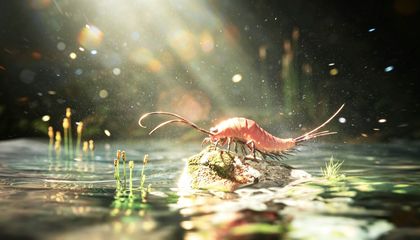
A fossilized insect discovered in Texas has revealed a surprising fact: it had 24 legs. This ancient creature, named Chosha praecursor, bridges the gap between water-dwelling crustaceans and modern land-dwelling insects. Researchers believe the fossil, found in a part of western Texas that was once underwater around 324 million years ago, represents a transitional species that lived during a critical period when aquatic life was transitioning to terrestrial life.
The specimen, described as a juvenile of the crustacean Tesnusocaris goldichi, was initially misidentified but was rediscovered and studied by paleoentomologist Erik Tihelka at the University of Cambridge. Using advanced imaging techniques, Tihelka identified several insect-like features, including whip-like antennae, a long tail, an egg-laying tube, an 11-section abdomen, and a three-segment thorax.
However, the creature also had three pairs of walking legs, and nine additional short legs on its abdomen, totaling 24 legs—a number far exceeding modern insects.
The researchers suggest that Chosha praecursor was neither fully aquatic nor fully terrestrial but rather a semi-aquatic creature, retaining some physical features that allowed it to live in both environments. The findings indicate that the transition from water to land may have been gradual, with early insects adapting to life on land over time. As these creatures evolved, they lost some of their legs, leading to the six legs characteristic of modern insects.
The discovery of Chosha praecursor and three other mysterious fossils with numerous legs suggests that insects underwent a complex evolutionary process to become the six-legged creatures we know today. This transition likely involved a series of adaptations that made it possible for some insects to move onto land, eventually giving rise to the vast array of insect species that exist today.
Written by urgent.news from Smithsonian's reporting — not their text. Machine-written — may contain errors; check the original before relying on it.