Meet ASTRID, the New High-Resolution Cosmological Simulation
The ASTRID cosmological simulation has run from the Universe's early days up to the present day, z=0. ASTRID is larger than some other simulations, and smaller than others. But with a higher number of particles, it has higher-resolution than its fellows. Among other things, this can tell astronomers where to look for gravitational waves from black hole mergers with future GW observatories.
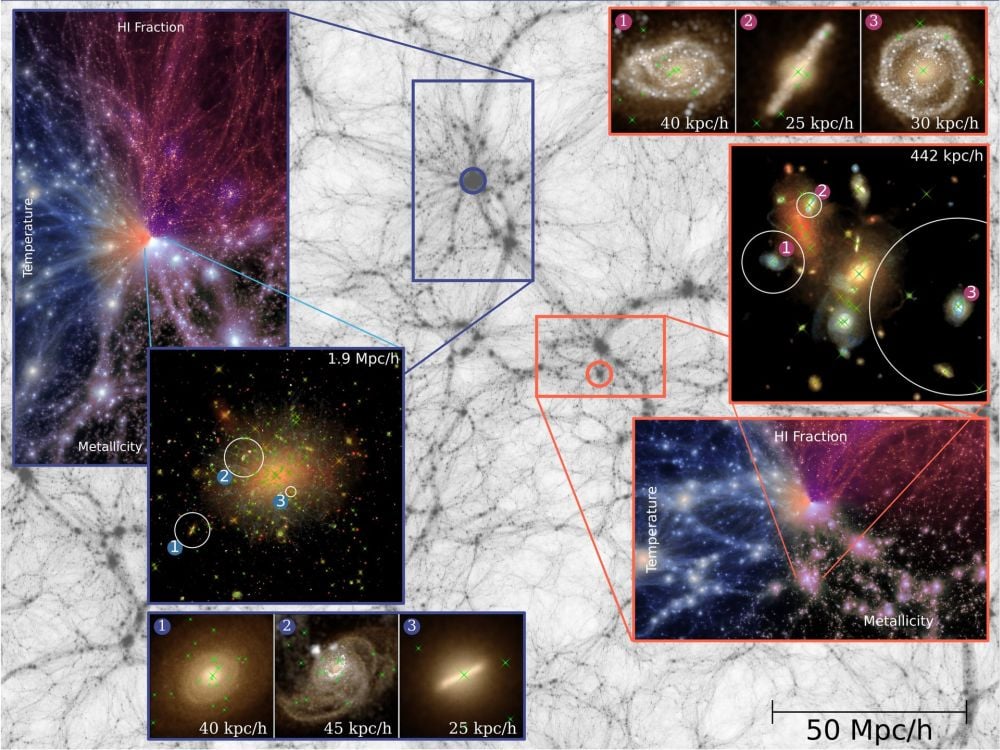
The ASTRID simulation is a high-resolution cosmological simulation that has been run from the Universe's earliest days up until the present. It contains 0.33 trillion particles in a box measuring 370 Mpc per side, making it one of the largest cosmological hydrodynamic simulations evolved to z = 0, or the present day. ASTRID's key feature is its large population of massive black holes, covering a wide mass range from 4 × 10^4 to 2 × 10^11 solar masses.
This simulation was used to address questions raised by observations from the James Webb Space Telescope (JWST), which revealed surprisingly massive black holes at the early stages of the Universe. The authors of the ASTRID study believe that their simulation can provide valuable insights into black hole mergers, which are of particular interest to gravitational wave (GW) observatories like the Laser Interferometer Space Antenna (LISA).
ASTRID can help predict the environments where GW sources are most likely to be detected, thus contributing to the understanding of the growth of black holes through mergers over cosmic time.
Written by urgent.news from Universe Today's reporting — not their text. Machine-written — may contain errors; check the original before relying on it.