Guest post: Why tough methane cuts are crucial for keeping warming ‘well-below’ 2C
Methane is a powerful greenhouse gas and the second-largest contributor to global warming after carbon dioxide (CO2). Methane traps heat… The post Guest post: Why tough methane cuts are crucial for keeping warming ‘well-below’ 2C appeared first on Carbon Brief .
Methane, a potent greenhouse gas and the second largest cause of global warming, is far more efficient at trapping heat in the atmosphere than carbon dioxide (CO2), but it exists for a much shorter time frame. Therefore, cutting methane emissions is a critical strategy for taming near-term global warming. However, most climate models and strategies focus on CO2, or lump all greenhouse gases together in a metric called "CO2 equivalent", which can obfuscate the unique challenges and opportunities presented by methane.
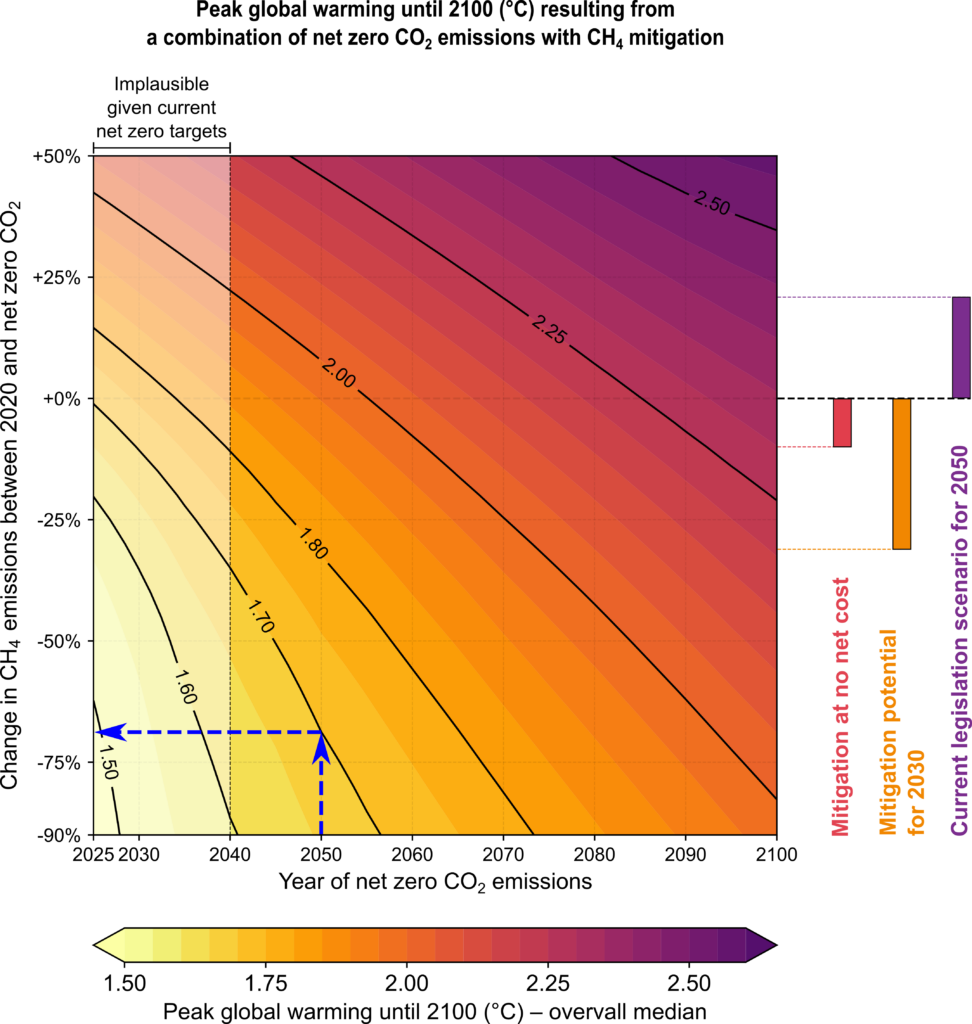
In a new study published in Communications Earth & Environment, researchers decouple CO2 and methane reduction targets and base their calculations on the ultimate goal of limiting global warming to well-below 2 degrees Celsius above pre-industrial levels. The findings reveal that without methane mitigation, peak warming could surpass 1.85 degrees Celsius, even under the most ambitious net-zero targets for CO2.
The research suggests that to meet the 2C target, CO2 reduction efforts must be paired with stringent methane emission cuts. While CO2 equivalent is a useful tool for comparing and combining greenhouse gases, it can be misleading when applied to methane, as the gas's atmospheric lifetime and warming potential differ from those of CO2.
Scientists use various metrics, such as Global Warming Potential (GWP) and GWP*, to convert methane and other gases into CO2 equivalents, but these calculations are only valid under specific assumptions about time horizons and baseline emissions. Only a handful of countries have set methane reduction targets, and the current methods for evaluating emission pathways often fail to account for the unique characteristics of methane.
Written by urgent.news from Carbon Brief's reporting — not their text. Machine-written — may contain errors; check the original before relying on it.