At the centre of the Ebola epidemic in Congo – crisis and hope
Professor Salim Abdool Karim describes the medical risks, conflict and public-health challenges he witnessed while assisting the Ebola response in Kinshasa and Bunia.
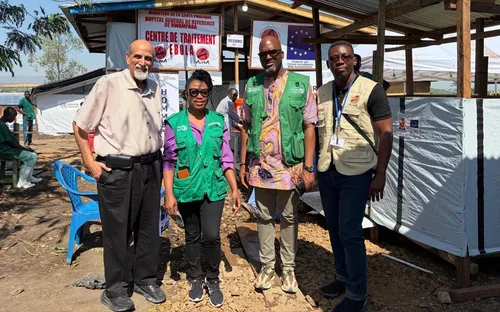
In May, the World Health Organization (WHO) and Africa Centres for Disease Control and Prevention (Africa CDC) declared an Ebola public health emergency due to rising cases in the Democratic Republic of Congo (DRC) and Uganda. Later, I traveled to Kinshasa and then to Bunia, the capital of Ituri province, to support the Africa CDC's Ebola response.
Here are three key facts about this particular Ebola outbreak: As of earlier this month, over 5,000 Ebola cases were reported in the DRC, with more than 2,500 deaths. Alarmingly, nearly half of all patients with Ebola died, often only being diagnosed after succumbing to the disease in their communities. The Bundibugyo virus, responsible for this epidemic, is spreading more rapidly than any other Ebola virus outbreak in history.
My firsthand experience in the DRC revealed the epidemic's devastating impact. In Kinshasa, I met Professor Jean-Jacques Muyembe at the Institut National pour la Recherche Biomedicale (INRB), who, along with Peter Piot, discovered the Ebola virus in 1976. Muyembe's laboratory identified the Bundibugyo virus in May, treating dying patients with fever and bleeding in Bunia.
The laboratory had a sophisticated, high-safety-level facility for Ebola tests. Unfortunately, my visit to Bunia was challenging due to the closed airport, requiring a UN humanitarian flight. The city's rustic charm contrasted with the harsh reality of thousands of displaced people living in tent camps due to ongoing conflict. I visited two Ebola Treatment Centers in Bunia, where government-run Evangelical Hospital, one of the largest Ebola facilities in the city, was impressive but faced challenges with limited space for isolation wards.
Despite the high risk, healthcare workers were not hesitant to enter Ebola wards, knowing the severe threat posed by highly infectious patients. In Rwampara hospital, five of the 18 Ebola patients were healthcare workers, including two doctors and an anesthetist, highlighting the real dangers they faced. As I returned to South Africa, I was reminded that our country is not immune to such outbreaks, and the DRC's epidemic will be difficult to contain due to political instability.
To control the epidemic, we must identify, isolate, bury, and follow up with all contacts of each Ebola patient. However, implementing these measures is nearly impossible in a war-torn region where most people lack homes. The current Ebola outbreak primarily affects the DRC and Uganda, but viruses can spread further without strong detection, diagnostics, and control measures.
Rapid diagnostic technology is crucial, as every case needs swift identification for isolation and contact tracing. On July 28th, Uganda's Ministry of Health declared an end to the Bundibugyo virus outbreak after 42 days without a new locally transmitted case. However, the DRC's epidemic continues unabated. Despite the immense challenges, the selfless commitment of thousands of volunteers aiding Ebola patients offers hope that we can overcome this outbreak, despite the obstacles.
Written by urgent.news from IOL's reporting — not their text. Machine-written — may contain errors; check the original before relying on it.
This story
This is one outlet's version. Read the fullest account.
- Ebola cases in DR Congo cross 6,000, death toll hits 2,911 nairametrics.com
- Aid group MSF opens new Ebola treatment centre in eastern Congo myjoyonline.com