57% of Firms Find Payment Fraud After Settlement
Uncertainty can turn a routine payment problem into a cost that is twice as large. That gap sits at the center of “Early Detection: Why Top Performing Firms Focus on Fraud Before It Starts,” a May edition of The 2026 Certainty Project produced by PYMNTS Intelligence in partnership with Plaid. The report finds that payment […] The post 57% of Firms Find Payment Fraud After Settlement appeared…
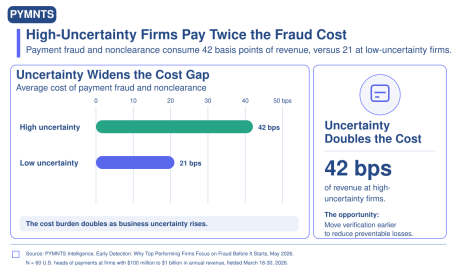
According to research by PYMNTS Intelligence in partnership with Plaid, 57% of firms discover payment fraud and nonclearance after the payment has settled. This is more than double the rate of 21% for firms that identify these issues before settlement. Payment fraud and nonclearance cost middle-market firms an average of 31 basis points of revenue per year, while high-uncertainty firms see costs double at 42 basis points.
Faster payment speeds increase fraud exposure, with firms experiencing this reporting 41 basis points in accounts receivable integrity costs, 60% higher than other firms. Poor integration of verification and fraud tools into accounts receivable workflows also adds to costs, with affected firms seeing 40 basis points in annual revenue losses.
Firms that use instant or real-time bank account verification are more likely to detect fraud before settlement, with 84% of recent adopters finding it highly effective. The findings suggest that firms can reduce fraud costs by implementing earlier checks to confirm account existence, ownership, and risk assessment before funds are transferred.
Written by urgent.news from PYMNTS's reporting — not their text. Machine-written — may contain errors; check the original before relying on it.