The GH¢19.8 billion mirage: Inside Ghana’s state enterprise turnaround
The headline number is a showstopper. For the first time in four years, Ghana’s State-Owned Enterprises (SOEs) broke their cycle of cumulative losses, posting a consolidated net profit of GH¢19.80 billion in 2025.
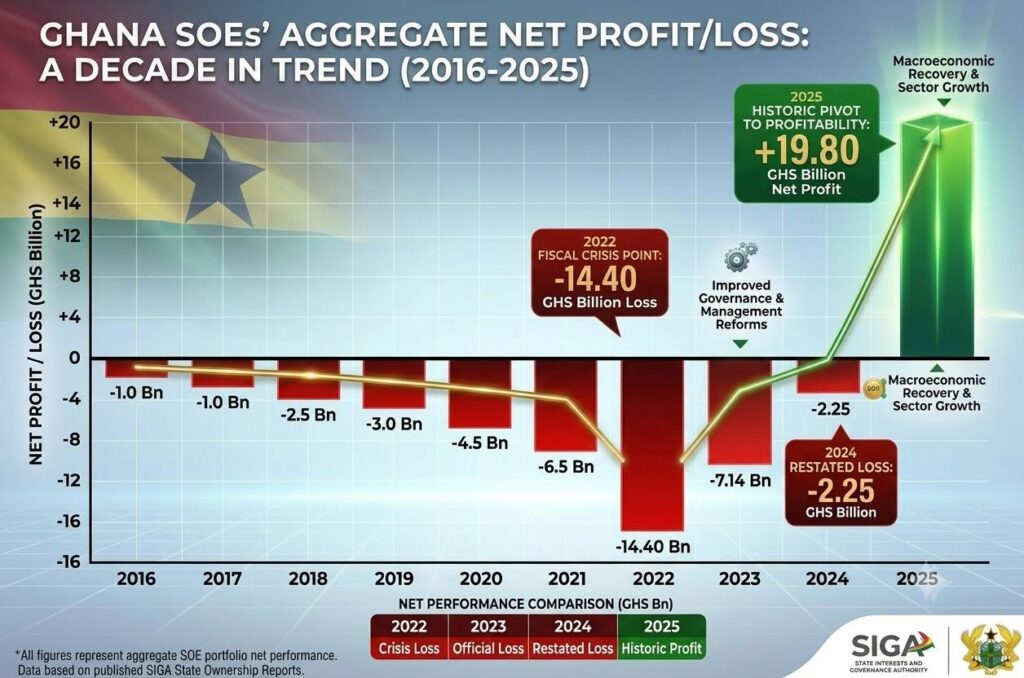
The Ghanaian State-Owned Enterprises (SOEs) achieved a remarkable record in 2025, finally posting a net profit of GH¢19.80 billion, marking the first time in four years that these enterprises stopped racking up losses. Total revenue for SOEs increased by 28.12% to GH¢176.43 billion. However, the rise in profitability was not solely due to operational improvements, but rather a combination of favorable macroeconomic conditions and accounting tricks.
The diversified revenue streams from non-energy sectors, such as agriculture, manufacturing, and infrastructure, played a significant role. Despite these improvements, the SOEs returned virtually no cash to the sovereign treasury. Rather than a genuine fiscal turnaround, the 2025 profit surge was largely a "macroeconomic illusion," with external factors, notably the stabilization of the cedi, accounting for a substantial portion of the profit increase.
Furthermore, the cash flow generated by the SOEs is highly concentrated, with only a few entities remitting any dividends to the state, while the majority swallowed their profits to cover debts and deficits. The Electricity Company of Ghana (ECG) alone holds a staggering GH¢82.31 billion in liabilities, posing a significant threat to the nation's fiscal stability.
The report suggests that the success of Ghana's SOEs can be attributed to strict governance, particularly in terms of public financial management (PFM) compliance. The authors recommend a shift from state-controlled management to private commercial management, particularly for companies operating in negative equity or with substantial debt burdens, such as ECG.
They propose a five-step plan, including scaling the JVC model, ring-fencing ECG's debt, enforcing a statutory dividend floor, codifying sanctions for non-compliance, and targeting Return on Invested Capital (ROIC) as a key performance indicator. While Ghana's SOEs have managed to avoid insolvency, the report emphasizes that the observed profit surge should not be mistaken for structural improvement and that genuine fiscal transformation requires concrete action.
Written by urgent.news from MyJoyOnline Ghana's reporting — not their text. Machine-written — may contain errors; check the original before relying on it.