See the Digitally Reconstructed Face of an Ancient Man Who Witnessed England’s Greatest Upheaval
The so-called “Conquest Man” was buried in England in 1079, just over a decade into the reign of William the Conqueror. Researchers recently analyzed the skeleton’s DNA and teeth to learn more about him
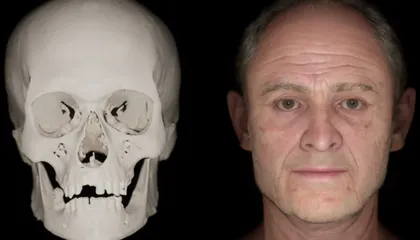
Nearly a thousand years ago, a man named Conquest Man was buried in St. Peter’s Church in Barton-upon-Humber, northern England. He was interred in an oak coffin, with a grass pillow supporting his head and three apple wood staffs beside him. This burial took place in the private church of one of William the Conqueror’s knights, indicating Conquest Man’s privileged status.
The strontium values in his teeth suggest he was from the Barton-upon-Humber area, while oxygen levels in his tooth enamel indicate he spent part of his adolescence in a colder climate. This inconsistency hints that he may have come from Scandinavia. Conquest Man likely lived during the reign of Cnut, who ruled England from 1016 to 1035, and was probably born around the time of William the Conqueror's invasion in 1066.
The facial reconstruction of Conquest Man depicts a man with thin lips, a receding hairline, and standing at just 5-foot-1-inch tall. While his exact origins and involvement in the Norman Conquest remain unknown, researchers believe it is likely that he came from Scandinavia, either directly or via Normandy, and may have served under William's forces.
Written by urgent.news from Smithsonian's reporting — not their text. Machine-written — may contain errors; check the original before relying on it.