Meet the Newly Discovered Fuzzy Fish Species Named After Mr. Snuffleupagus From 'Sesame Street'
The ghost pipefish's scruffy appearance probably helps it look like floating algae, allowing it to blend in with its environment. Researchers had been on the hunt for this strange creature for years after first spotting one more than two decades ago
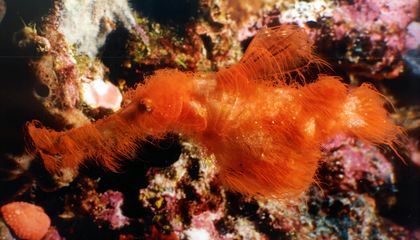
In 2003, Australian marine biologist David Harasti stumbled upon an unusual fish while scuba diving off Papua New Guinea. The red, fuzzy creature was unlike anything he had ever encountered, leading him to snap a quick photo before the elusive specimen vanished. This moment sparked a years-long search for the mysterious fish. In 2022, Harasti and ichthyologist Graham Short from the California Academy of Sciences and the Australian Museum finally captured two specimens at the Great Barrier Reef.
After extensive analysis, they determined the fish belonged to a new species named Solenostomus snuffleupagus, after the shaggy "Sesame Street" character Mr. Snuffleupagus, as detailed in the August issue of the Journal of Fish Biology.
The fuzzy appearance of S. snuffleupagus, a 1.5-inch-long ghost pipefish, mirrors the beloved Muppet, demonstrating the power of natural selection, according to marine biologist Milton Love from the University of California, Santa Barbara. The fish's resemblance to Mr. Snuffleupagus isn't just aesthetic; it serves an evolutionary purpose, as the species resembles floating tufts of algae, blending in with its surroundings and even mimicking algae's movements.
The researchers also discovered that S. snuffleupagus has more vertebrae than its relatives and that its genetic makeup suggests it diverged from other ghost pipefish around 18 million years ago. Additionally, they found remains of smaller fish in the stomach of one specimen, marking the first documented case of fish-eating in the Solenostomus genus.
Interestingly, while seahorses and true pipefish are known for paternal care, ghost pipefish like S. snuffleupagus do not exhibit this behavior. Females hold eggs in modified pelvic fins until they hatch. Harasti chose to name the species after Mr. Snuffleupagus due to the creature's elusive nature and physical resemblance, receiving the Sesame Workshop's blessing for the name.
The researchers determined that S. snuffleupagus likely inhabits the southwest Pacific Ocean, including areas in Australia, Papua New Guinea, Fiji, New Caledonia, and Tonga. The fish also exhibits varying colors, including oranges and purples, further emphasizing their camouflage abilities. The discovery underscores the importance of coral habitats, as they harbor cryptic creatures like S. snuffleupagus, even in well-surveyed areas like the Great Barrier Reef.
Written by urgent.news from Smithsonian's reporting — not their text. Machine-written — may contain errors; check the original before relying on it.