How do lava-world exoplanets keep their atmospheres?
A new study from researchers at Stanford University helps explain how hot lava-world exoplanets orbiting close to their stars can maintain their atmospheres. The post How do lava-world exoplanets keep their atmospheres? first appeared on EarthSky .
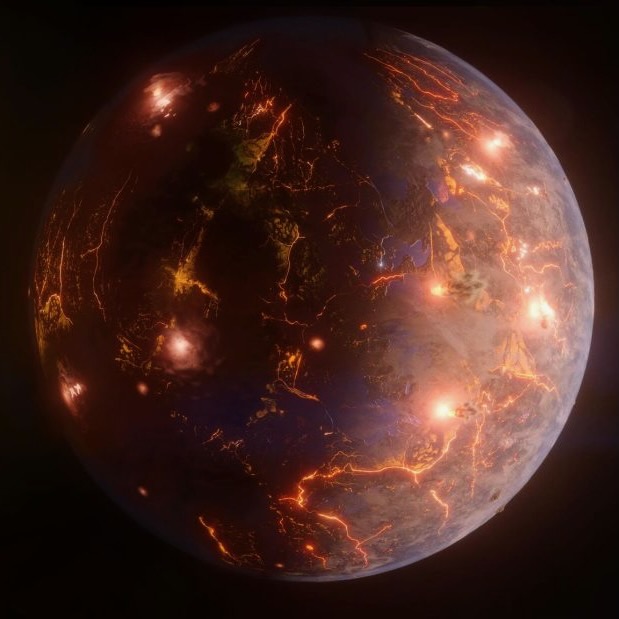
In a surprising twist, some lava-world exoplanets have been found to retain thick atmospheres despite their close proximity to their stars. These rocky exoplanets orbit so close to their stars that the intense heat should melt their surfaces and cause them to lose their atmospheres due to intense radiation and stellar winds. However, a new study from researchers at Stanford University suggests that these planets can sustain their atmospheres through a process called outgassing, where gases slowly escape from below the planets' surfaces.
The study, published in The Astrophysical Journal Letters on August 25, 2026, proposes an entirely new region around stars called the "cosmic sandbar." This region extends the "cosmic shoreline," a previous boundary believed to separate airless worlds from those capable of sustaining atmospheres. In our solar system, Earth and Venus are located on the cosmic shoreline, and they remain cool enough that radiation from the sun doesn't burn off their atmospheres.
But the cosmic sandbar presents a different scenario. It is analogous to sandy ridges that form offshore in oceans and is where some lava-worlds can maintain their atmospheres. According to the researchers, gases released from their molten interiors replenish what stellar radiation strips away. A good example is 55 Cancri e, a super-Earth almost eight times the mass of Earth, which orbits its star about 20 times closer than Mercury orbits the sun.
Despite its proximity, it has a thick atmosphere discovered by the James Webb Space Telescope in 2024.
Written by urgent.news from EarthSky's reporting — not their text. Machine-written — may contain errors; check the original before relying on it.