Dose calculations reveal how patient motion impacts proton minibeam therapy
A Monte Carlo-based 4D dose calculation framework assesses the uncertainties for realistic clinical treatments The post Dose calculations reveal how patient motion impacts proton minibeam therapy appeared first on Physics World .
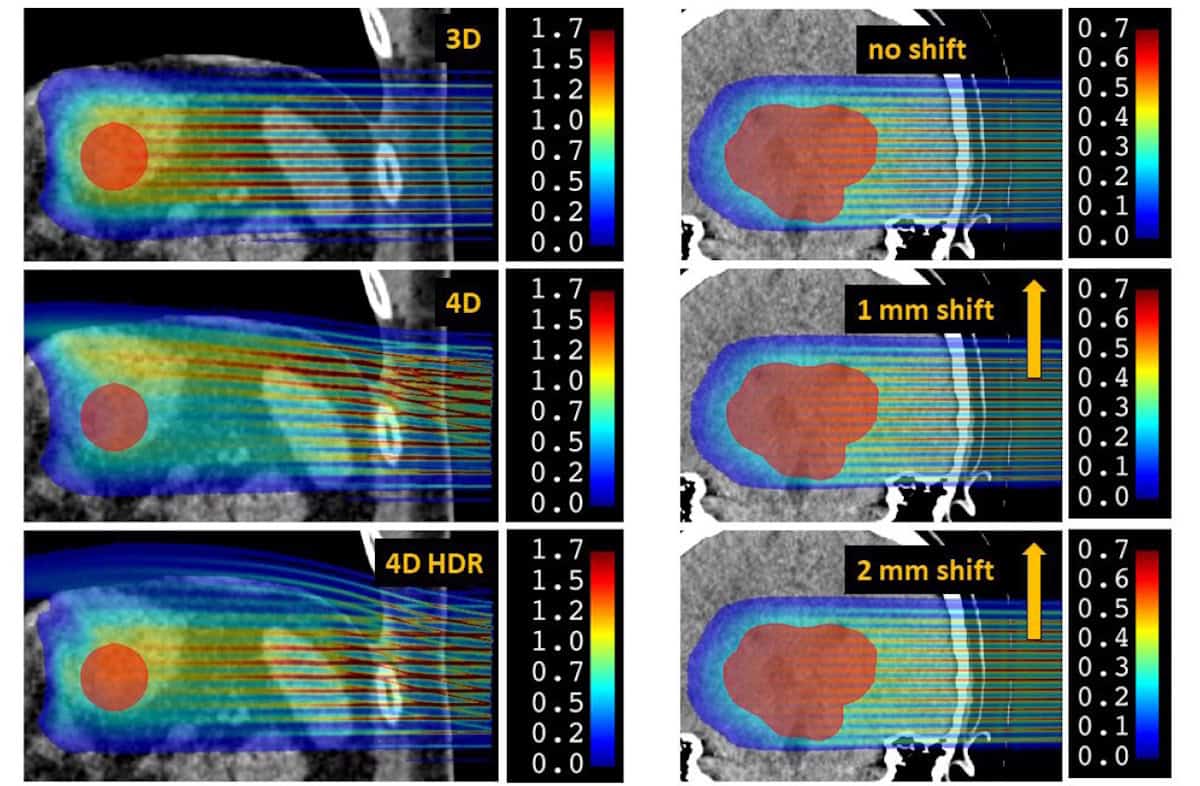
Proton minibeam radiotherapy (pMBRT) is an innovative cancer treatment that employs narrow proton beams to create alternating high and low dose regions, before converging into a uniform dose within the target volume. A French research team at Institut Curie has developed a Monte Carlo (MC)-based framework to quantify the impact of patient motion on pMBRT dose distribution, crucial as motion can diminish the sparing effect on healthy tissue.
The team's 4D dose calculation workflow relies on time-resolved Monte Carlo simulations using a 4D CT dataset of the patient's anatomy and breathing motion over one respiratory cycle, along with a proton pencil-beam scanning (PBS) treatment plan generated on a reference CT. They validated the tool on a thoracic motion phantom and later employed it to evaluate the impact of motion on representative clinical cases.
For large breathing movements, the simulation revealed significant variations in dose patterns, affecting two key parameters: the peak-to-valley dose ratio (PVDR) and the minimum dose received by 95% of the target volume (D95%). At a depth of 5 mm, the mean PVDR dropped from 11.9 in a 3D scenario to 6.7 in the 4D motion scenario.
The high-dose rate scheme only slightly mitigated this degradation. Furthermore, patient motion in intracranial treatments caused a reduction in the mean PVDR by 10% with a 1 mm shift, and 24% with a 2 mm shift.
The researchers conclude that their 4D dose reconstruction workflow offers a valuable tool for assessing the impact of organ motion on pMBRT. Without specific motion management strategies, only intracranial treatments with movements below 1 mm are likely to remain robust against interplay effects. Future work will focus on validating calculation tools and measurement procedures for clinical application.
Written by urgent.news from Physics World's reporting — not their text. Machine-written — may contain errors; check the original before relying on it.