Telescopium the Telescope is below the Teapot
Telescopium the Telescope is a constellation that appears best in southern skies, south of the Teapot. Look for it in dark skies. The post Telescopium the Telescope is below the Teapot first appeared on EarthSky .
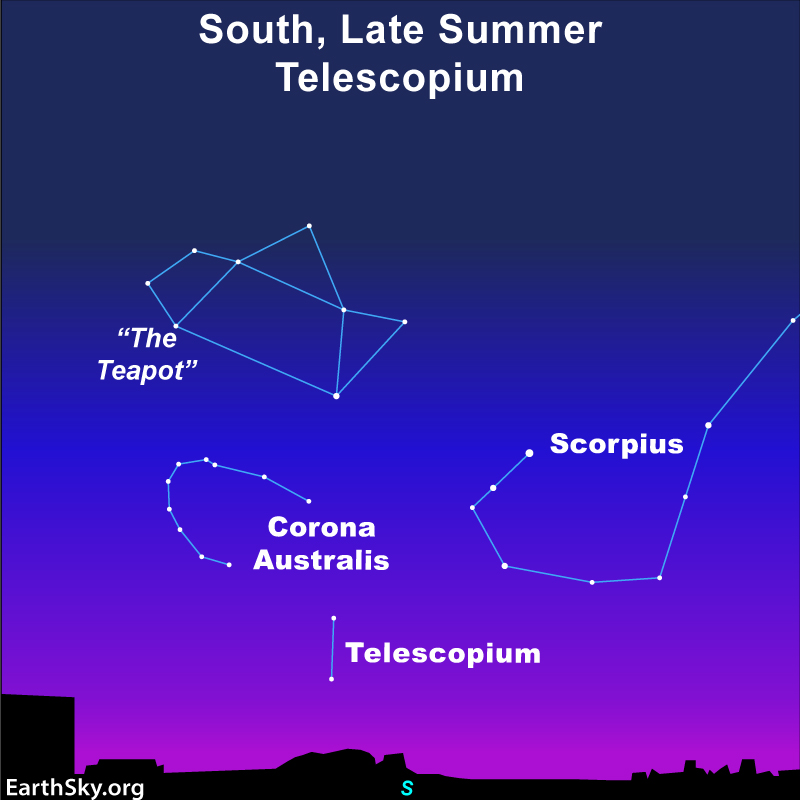
Telescopium, the constellation named after the telescope, is most visible from the Southern Hemisphere. For observers in the Northern Hemisphere, particularly those at 30 degrees north latitude like Houston, Texas, Telescopium appears low on the horizon just after sunset. In the Southern Hemisphere, however, this tiny constellation is high in the sky throughout the night.
From the Northern Hemisphere, Telescopium is best spotted in late summer and early fall (winter and spring in the Southern Hemisphere). The dimmest star in the constellation, Alpha Telescopii, has a magnitude of 3.51. Its two brightest stars, Alpha and Zeta Telescopii, are rather close to each other and make up the bulk of the constellation's shape.
The constellation sits near the borders of Corona Australis and Sagittarius the Archer. To locate it, look for the Teapot of Sagittarius and the curve of Scorpius the Scorpion. Once you find these constellations above the horizon, Telescopium will be visible below them. Remember, due to its dim stars, viewing Telescopium will be much easier with a telescope.
Written by urgent.news from EarthSky's reporting — not their text. Machine-written — may contain errors; check the original before relying on it.