Plains and Midwest bracing for dangerous temperatures
Dangerous heat that has scorched the Southwest for days is expected to spread to the nation's midsection.
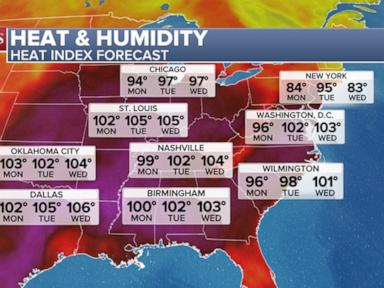
The Plains and Midwest regions are bracing for dangerous heat as temperatures soar. Nighttime temperatures in these areas will bring little respite from the intense heat that has been plaguing the Southwest for days. Cities such as Kansas City, Missouri, and Des Moines, Iowa, will experience heat indices making it feel like 100 degrees starting Sunday and continuing into the first week of September.
Chicago is expected to feel like the upper 90s by Tuesday, with heat index values exceeding 100 degrees in Charlotte, Raleigh, North Carolina; Richmond, Virginia; and Washington, D.C.
The southern Plains and Mid-Atlantic regions will see minimal relief from the heat, with nighttime lows remaining in the 70s for several days. While some parts of the Northeast will avoid this wave of dangerous temperatures, most of the region is expected to experience hot and humid conditions. As the heat moves eastward this week, wet and stormy weather may develop in the Upper Midwest and Northeast, with a potential for spotty flash flooding and severe storms.
An earlier flash flood event in Arizona's Grand Canyon National Park resulted in the evacuation of 62 people from the Phantom Ranch area. Additional evacuations are planned, and the National Park Service is seeking information on over 20 individuals who may be missing or unaccounted for following the incident. In Utah, flooding of Cottonwood Creek in Orangeville, approximately 150 miles southeast of Salt Lake City, prompted evacuations of several homes and apartments.
More flash flooding is anticipated on Sunday afternoon in parts of the West, as a new round of thunderstorms develops, fueled by monsoonal moisture.
Flood watches have been issued across portions of Arizona, Utah, and Colorado, including cities like Tucson, Phoenix, Flagstaff, Arizona, Cedar City, Utah, and Grand Junction, Colorado. Additional strong thunderstorms are possible in the region, bringing strong wind gusts, frequent lightning, and blowing dust.
Written by urgent.news from ABC News (US)'s reporting — not their text. Machine-written — may contain errors; check the original before relying on it.