Old Australian courthouse finds new life as Nihon University facility
Completed in 1892, the former Newcastle Courthouse, distinguished by an arched entrance, is listed as a New South Wales cultural heritage site.
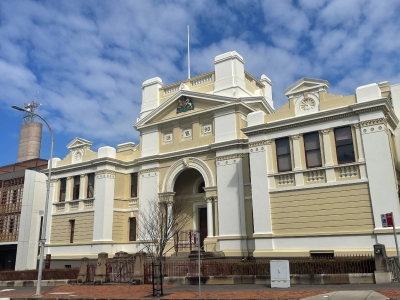
Newcastle, Australia – A 134-year-old former courthouse has been repurposed as a facility for Japan’s Nihon University. Completed in 1892, the former Newcastle Courthouse, known for its arched entrance, has been recognized as a New South Wales cultural heritage site. Following the court’s relocation to a new building in 2016, Nihon University acquired and restored the property. Since 2024, the university has utilized the former courthouse alongside classrooms and lodging facilities constructed adjacent to it.
The courthouse houses various courtrooms, holding cells, and spaces where defendants met with their legal counsel, all preserved in their original layout. A standout feature is the defendant’s dock within the former Grand Courtroom, encircled by a wooden railing and accessible via a dedicated staircase leading to a cell below. In August, students participating in a study program in Australia held a mock trial in the former Grand Courtroom.
The smaller courtroom is named the Yamada Room in honor of Akiyoshi Yamada, a former Japanese justice minister and the founder of Nihon University’s predecessor, Nihon Law School, established in 1889. Both Nihon University and the former courthouse trace their origins to a similar time period. Takenari Shiba, from Nihon University’s office for internationalization promotion, emphasized the significance of preserving the site’s historical value, stating that the university hopes it will enable students to learn from the past.
Students at Nihon University have shared their impressions of the courthouse. Haruhisa Ikenaga, a second-year law student, commented that the courtroom felt authentic and provided a vivid sense of its differences from Japan. Hana Harada, a second-year student in the university’s College of Humanities and Sciences, noted that seeing the cells for the first time and the scars on the walls helped her imagine the emotions of individuals who had been incarcerated there.
Written by urgent.news from Japan Times's reporting — not their text. Machine-written — may contain errors; check the original before relying on it.