Berlin: Will a New Directive End the Argument About Traffic Bollards?
Especially the Greens love traffic-calming measures such as bollards, while the CDU does not. Now, the Transport Senator took a decision.
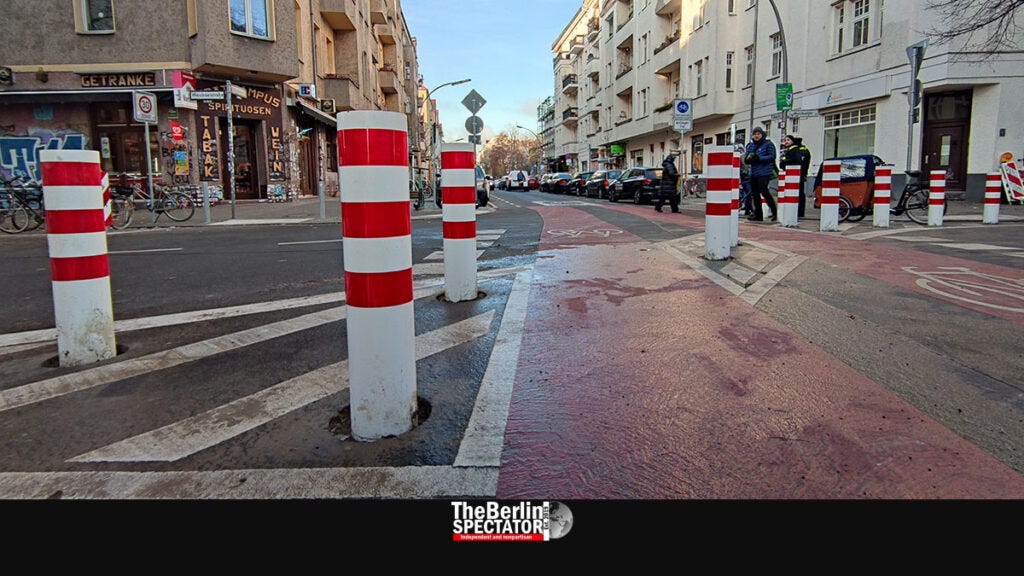
Berlin, August 30th, 2026 (The Berlin Spectator) – Berlin’s Commissioner for Urban Affairs, Ute Bonde, has proposed a new administrative directive that could limit the use of traffic bollards in residential areas. Known as “Kiezblocks”, these barriers, while intended to slow traffic, have become a contentious issue. The directive tightens the rules for when such barriers can be employed, shifting more authority to the city-state government from individual districts.
The move follows disputes between Bonde’s CDU party and traffic-calming advocates, notably in the Mitte district, where a planned Kiezblock was halted. Instead, Mitte will now use one-way streets to calm traffic. Bonde introduced the policy shift recently, and the draft directive was recently sent to district councilors. The central principle of the directive is that road closures using bollards should be a last resort.
For projects that could impact broader road networks, public transit, or commercial traffic, the responsible Senate transport department must be notified early. If a district’s traffic-calming plan could have a significant impact, the Senate’s mobility department must formally approve it. Bollards will only be permitted as a last resort, after other options have been evaluated and found ineffective, and only after formal justification is submitted to and approved by the Senate Administration of Transport.
Emergency services can effectively veto the installation of barriers. The directive also applies to other traffic-calming measures, requiring districts to meet a proportionality standard and weigh the mildest effective option. It will also require districts to document a full evaluation process, considering the needs of commercial traffic, street cleaning services, emergency responders, and police.
The directive could affect existing bollards if local conditions change significantly. The Berlin state elections are scheduled for September 20th, 2026, and Bonde defended the timing of the directive as "absolutely routine administrative business."
Written by urgent.news from The Berlin Spectator's reporting — not their text. Machine-written — may contain errors; check the original before relying on it.