Trump says US is taking partial control of Venezuela's vast oil reserves
United States President Donald Trump on Friday announced an unprecedented push to take control of a fifth of Venezuela’s vast oil reserves, betting that American companies can revive the Opec nation’s battered energy industry while delivering a new source of crude to help bring down US fuel prices. Trump provided few details about the agreement, saying only that the US had secured majority…
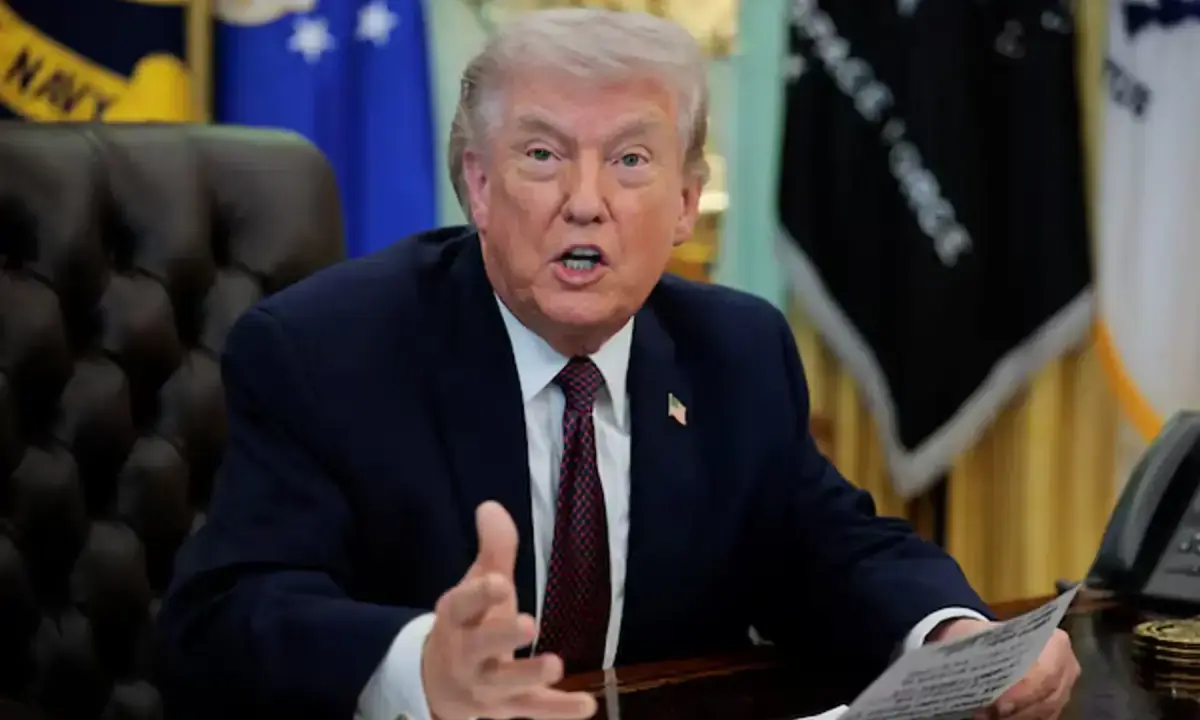
U.S. President Donald Trump announced on Friday an unprecedented effort to gain control of a fifth of Venezuela's extensive oil reserves, aiming to revitalize the Opec nation's energy sector and potentially lower fuel prices in the United States. The agreement grants the United States majority control over more than 65 billion barrels of Venezuela's proven oil reserves, formed through a partnership with private businesses.
Venezuelan President Delcy Rodriguez welcomed the deal, stating it would enhance the economy and government income.
The new arrangement represents a significant escalation in the U.S. involvement in Venezuela's oil industry, as the Trump administration endeavors to revive the country's production and secure additional crude for American refineries. Venezuela boasts the world's largest proven oil reserves, yet currently only produces around 1.25 million barrels per day, a fraction of its potential due to years of underinvestment, mismanagement, and sanctions.
White House spokesperson Jared Kushner announced the deal, stating that Secretary of State Marco Rubio and Secretary of Defense Pete Hegseth have been working closely with Rodriguez in securing majority U.S. control. The agreement, which has yet to be fully disclosed, would grant American companies long-term access to a cluster of Venezuelan oilfields and assure a steady supply of crude to the United States.
Venezuelan authorities are set to sign agreements next week granting new exploration and production rights to various companies, predominantly U.S. firms.
The fields are located in the Orinoco Belt and Lake Maracaibo regions, with a list provided by Reuters indicating their specific locations. While the U.S. structure of the agreement and the companies involved remain undisclosed, it is expected to face legal and constitutional challenges in Venezuela, where the state retains oversight of crucial oil industry activities.
The deal is seen as a win-win for both nations, with the U.S. gaining a stable and low-cost oil supply, potentially reducing gasoline prices, and Venezuela reaping nearly $100 billion in private investment, generating thousands of high-paying jobs, and bolstering the country's economy. Rodriguez claimed the agreement would facilitate a substantial increase in production through the development of 17 strategic fields and generate $209 billion in tax revenue for Venezuela, contributing to industry recovery, modernization, and overall economic growth.
However, experts caution that more details about the agreement's legal and financial structure are needed before assessing its potential to attract considerable investment. Additionally, the impact on gasoline prices in the short term remains unclear, as developing the necessary infrastructure for Venezuela's heavy crude production, transportation, and refining could take years.
David Goldwyn, president of Goldwyn Global Strategies, expressed uncertainty about the agreement's legal validity under Venezuela's constitution and hydrocarbons law, noting that there are no precedents for a U.S. government lease to operate oil fields. Goldwyn also questioned whether the plan will overcome the myriad challenges that have deterred investment in Venezuela for years, including political uncertainty, an inadequate power grid, limited export capacity, and government discretion over the industry.
Since removing President Nicolás Maduro, the U.S. has been striving to secure a reliable source of Venezuelan crude for American refineries while promoting domestic investment in the country's oil sector. Facing pressure ahead of the midterm elections in November, the administration is under scrutiny to alleviate consumer concerns over rising gasoline prices.
Cheaper oil supplies and expanded production could potentially address these concerns. The U.S. is also exploring the possibility of crude swaps with U.S. producers to replenish the Strategic Petroleum Reserve, the nation's oil stockpile. Venezuela nationalized its oil industry in the 1970s, resulting in the consolidation of PDVSA under state control.
During Hugo Chavez's presidency, the government tightened control, forcing foreign producers into state-led joint ventures and subsequently expropriating assets, including those operated by ExxonMobil and ConocoPhillips. Under Maduro's leadership, Venezuela's production has significantly declined.
Written by urgent.news from Dawn Business's reporting — not their text. Machine-written — may contain errors; check the original before relying on it.
This story
This is one outlet's version. Read the fullest account.
- Trump says US is taking partial control of Venezuela's vast oil reserves brecorder.com
- Trump says US is taking partial control of Venezuela's vast oil reserves, but offers few details about agreement dawn.com
- Trump announces ‘biggest oil deal in history’ giving US majority control of 65 billion barrels of Venezuelan reserves livemint.com
- Trump announces 'historic' US-Venezuela oil deal that he says will lower gas prices abcnews.com
- US-Venezuela oil deal: Trump announces agreement over 65 billion barrels of reserves thehindubusinessline.com
- Trump says US is taking partial control of Venezuela's vast oil reserves news.sky.com
- Amid high gas prices and shrinking crude stockpile, Trump says U.S. to take control of 65 billion barrels of Venezuelan oil reserves fortune.com
- Trump says US is taking partial control of Venezuela’s vast oil reserves businesstimes.com.sg