Urgent.News

What's breaking now, across thousands of outlets.

AI

Künstliche Intelligenz: Deutschlands jüngste KI-Professorin räumt mit den größten Mythen auf

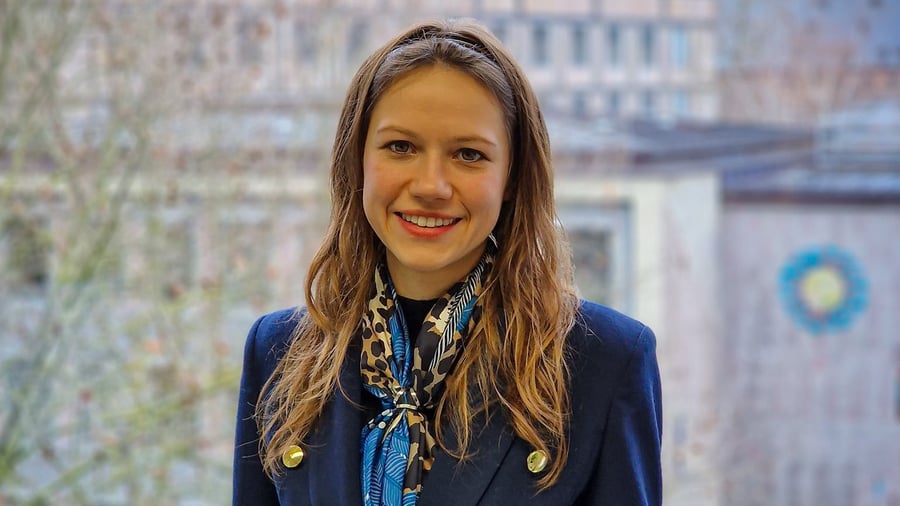
Mit gerade mal 30 Jahren hat Alicia von Schenk den Lehrstuhl für „Economics of AI“ an der Uni Würzburg gegründet. Sie rät hinter den aktuellen Hype um die Technologie zu schauen.

Künstliche Intelligenz: Deutschlands jüngste KI-Professorin räumt mit den größten Mythen auf

<AI Professor Debunks Biggest Myths>

Alicia von Schenk, a young professor in Germany, is challenging common misconceptions about artificial intelligence. Born with an early talent, she began her education at the age of four and later earned a 1.0 grade in her school leaving exam at 15. She studied mathematics and economics at Frankfurt and Heidelberg universities, graduating with a summa cum laude degree and the highest distinction in economics, focusing on the impact of AI.

At just 30 years old, she became a professor on a lifelong tenure track, a position typically taken at nearly 44 years old in Germany.

Today, von Schenk heads the chair for "Economics of AI and Human Behavior" at the Julius-Maximilians-Universität in Würzburg, one of the few programs in Germany that explicitly focuses on the economic and behavioral effects of AI. Recognized as a national prodigy, von Schenk explains how she achieved such early success and her perspective on the current AI boom.

1. There is not just one AI

Despite the overwhelming hype, von Schenk clarifies that there is not a single AI. She describes AI as a collective term encompassing various technologies, ranging from simple statistical tools to complex neural networks in machine learning. "We call all of that AI," she says, emphasizing that this broad categorization can be too simplistic.

Written by urgent.news from Handelsblatt's reporting — not their text. Machine-written — may contain errors; check the original before relying on it.

This story

This is one outlet's version. Read the fullest account.

Read the original at handelsblatt.com →

More in AI

Tech coalition sounds alarm over AI cyber threats

More than 100 technology, financial and security organisations have warned that the world has only months to strengthen digital defences before increasingly capable artificial intelligence systems…

  • Over 100 tech, financial, security groups warn of AI cyber threats
  • AI models can identify vulnerabilities, generate malicious code autonomously
  • Coalition urges bolstering digital defenses, sharing threat intelligence

Design, Optimization, and Deployment of a Hybrid Agentic Retrieval-Augmented Generation (Agentic-RAG) Architecture

Abstract Traditional RAG pipelines usually work deterministically by using only static vector search[cite: 1]. Because of this, vocabulary mismatches can occur when searching for exact words or…

  • Introduces Agentic Hybrid RAG architecture to address RAG limitations
  • Combines dense semantic search, exact keyword search, and autonomous LLM agent
  • Uses FAISS IndexFlatIP for dense search, BM25Okapi for sparse lexical search

This creator got 'micro-canceled' for promoting Claude. She says AI use is becoming a social taboo.

The internet is getting their digital pitchforks out for influencers who promote AI. We spoke to a creator who was "micro-canceled."

  • Ottawa-based influencer Emma Orhun faced backlash for promoting Anthropic's Claude AI.
  • Orhun labeled as "micro-canceled" after receiving harsh comments on social media.
  • Despite criticism, Orhun uses AI for technical tasks but avoids AI for artistic purposes.

More from Saturday 29 August →