Data center at Southeast Asia's top university runs on living human brain cells, fed sugar every 3 days
A rack of 20 computers powered by living human neurons has gone into operation at the National University of Singapore, the first deployment of Australian startup Cortical Labs' biological hardware outside its home market.
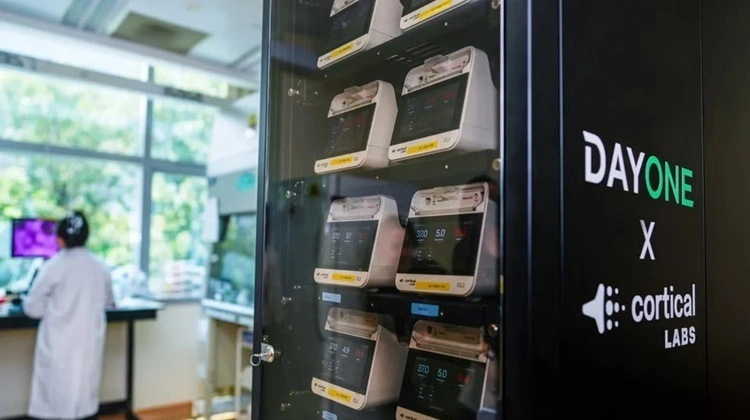
On July 16, researchers at the National University of Singapore (NUS) Medicine, in collaboration with data center developer DayOne and Cortical Labs, inaugurated a prototype data center within the university's Life Sciences Institute. This groundbreaking installation, dubbed the CL1, was showcased to over 80 industry and academic guests before being unveiled publicly on August 17.
The CL1 is heralded as the first commercial, code-deployable biological computer, marking a significant step towards Singapore's first large-scale biological data center.
The CL1 utilizes lab-grown human neurons grown from stem cells, which are interconnected with hardware via microelectrode arrays. These neurons, fed a mixture of sugar, micronutrients, and pH buffers every three days, significantly reduce power consumption compared to traditional data centers. Each unit consumes approximately 30 watts, including its life support systems, and generates minimal heat, rendering cooling systems obsolete.
This is a stark contrast to conventional data centers, which draw substantial power, with Nvidia's H100 SXM accelerator reaching up to 700 watts and its DGX H100 server consuming around 10.2 kilowatts.
The neural network in the CL1, composed of roughly 800,000 lab-grown human neurons, is designed to handle specific tasks where data is scarce, such as drug discovery, humanoid robotics, cybersecurity, and fraud detection. Unlike conventional AI systems, the biological computer leverages the unique capabilities of neurons, making it particularly suitable for applications that require sparse or shifting data.
The technology is positioned as a supplement to existing AI rather than a direct replacement, emphasizing its potential in solving problems where conventional systems face limitations.
Written by urgent.news from VnExpress International's reporting — not their text. Machine-written — may contain errors; check the original before relying on it.