CrowdStrike’s post-Mythos surge: Moat, momentum and the blast-radius test
CrowdStrike Holdings Inc.’s most recent earnings print shows that Anthropic PBC’s Mythos model transformed artificial intelligence security from something chief information security officers needed to worry about down the road into an immediate buying event. The company’s entrenched position in endpoint – along with its single lightweight agent, proprietary intelligence and a rapidly expanding…
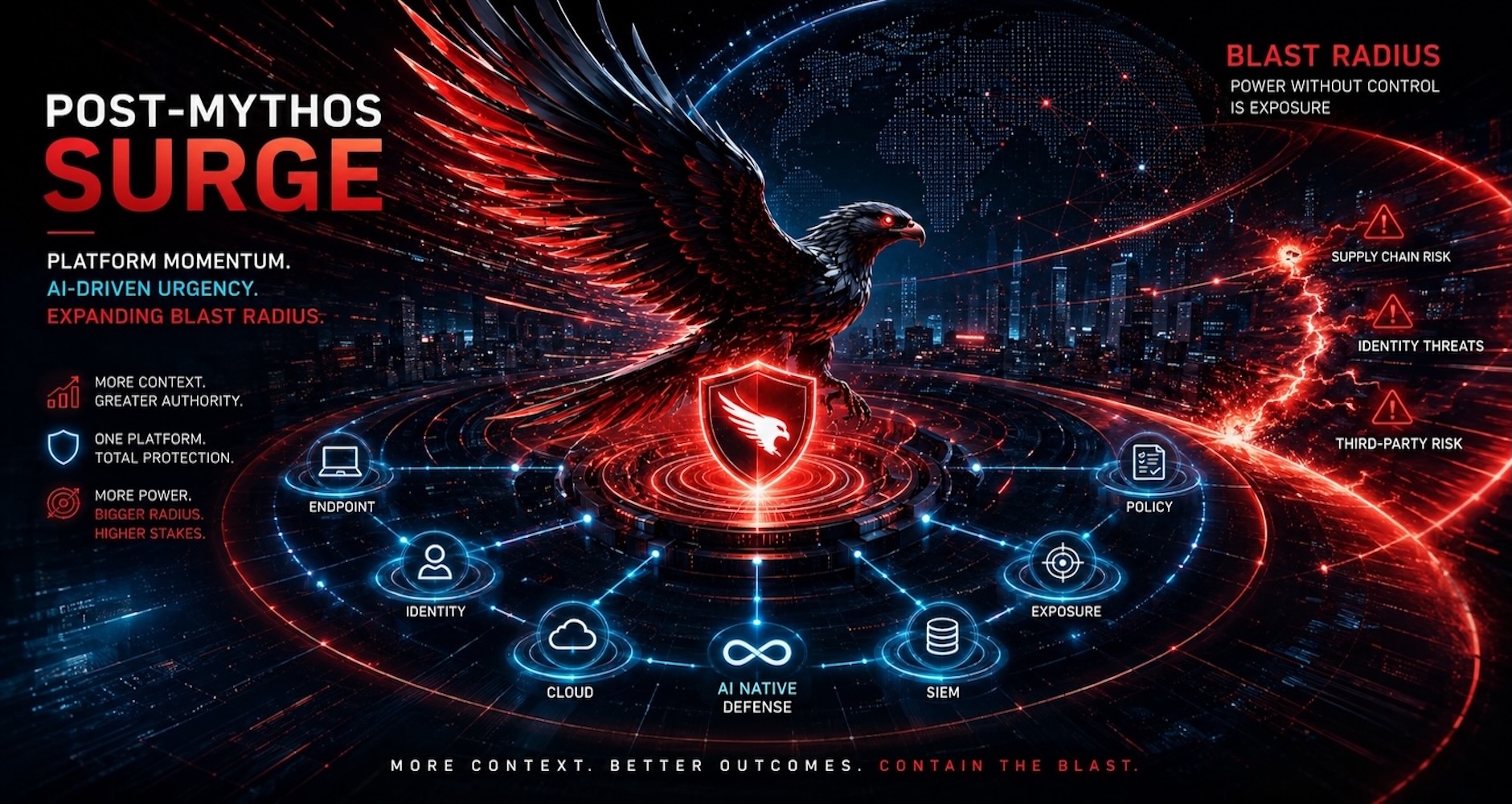
CrowdStrike’s latest earnings report indicates that Anthropic PBC’s Mythos model has transformed artificial intelligence security from a future concern to an immediate buying opportunity. The company’s strong position in endpoint security, along with its single lightweight agent, proprietary intelligence, and an expanding range of modules, has turned Mythos urgency into record new logo momentum and record net new annual recurring revenue.
CrowdStrike aims to hit the $10 billion ARR target by FY 2031, a goal they set during last year's investor day. The key driver of commercial adoption is Falcon Flex, which customers interpret as more than just a contracting tool; they see it as offering lower complexity, faster deployment, and improved unit economics. However, it is crucial to remember that while expanding Falcon's context and data improves its performance, it also increases AI authority, raising the importance of resilience and controlling AI to prevent potential risks from a wider blast radius.
CrowdStrike’s recent performance demonstrates the significant tailwind Mythos and other advanced models provide to the company. This analysis will delve into how CrowdStrike and Falcon are converting the AI threat from Mythos and other frontier models into platform expansion, incorporating data from Qualitate, a primary data intelligence firm that has conducted numerous buyer surveys on CrowdStrike and other firms.
Furthermore, it will explore the importance of containing the new blast radius as a means to achieve operational, technical, and financial sovereignty in the AI era. Comparing CrowdStrike's Q1 and Q2, Mythos caused significant chaos in SecOps teams and boardroom discussions in Q1, with CISOs being bombarded with questions about the implications, exposure, and mitigation strategies.
By Q2, this chaos transformed into substantial cash flow for CrowdStrike, as highlighted by the impressive numbers below. The company delivered $333 million in net new ARR, a 51% year-over-year increase and more than $45 million above the high-end guidance. Ending ARR reached $5.84 billion, with growth accelerating for the fourth consecutive quarter.
New-logo net new ARR hit a record, while gross retention and net dollar retention also improved. Management raised their full-year net-new-ARR growth outlook by 630 basis points, to 34% at the midpoint of their guide. This was a notable beat and raise, with the stock responding positively – up over 20% at Thursday's afternoon close.
Preliminary data from Qualitate reveals that CrowdStrike is prominently discussed in Mythos-related conversations within 1,249 customer conversations. A late June 2026 Qualitate survey with a large enterprise customer states that the strategy shifted from indifference towards AI security to a need to address Mythos and AI capabilities due to potential vulnerabilities.
While this can be attributed to Mythos, the breadth of CrowdStrike's Falcon platform offers multiple ways to monetize this urgency. Notably, AI detection and response (AIDR) were mentioned sixteen times during CrowdStrike's earnings call, clearly aligning with the post-Mythos surge. However, this development is more complex than just an AIDR story.
The Qualitate data indicates that much of Mythos-related buyer comments focus on application security, which can lead to downstream buying activity based on the customer's position in the buyer journey. For instance, application security may identify code vulnerabilities, but customers may also want to understand how those vulnerabilities create exposures across their estate, potentially leading to a posture management purchase.
Written by urgent.news from SiliconANGLE's reporting — not their text. Machine-written — may contain errors; check the original before relying on it.