Ahsan eyes USD1trn economy by 2035
ISLAMABAD: Federal Minister for Planning, Development and Special Initiatives Ahsan Iqbal said Pakistan has set the ambition of becoming a USD 1 trillion economy by 2035, but stressed that the objective was not simply to achieve a numerical GDP target. Addressing a visiting delegation of MBA students from Harvard Business School (HBS) on Friday, he said Pakistan’s central economic challenge is to…
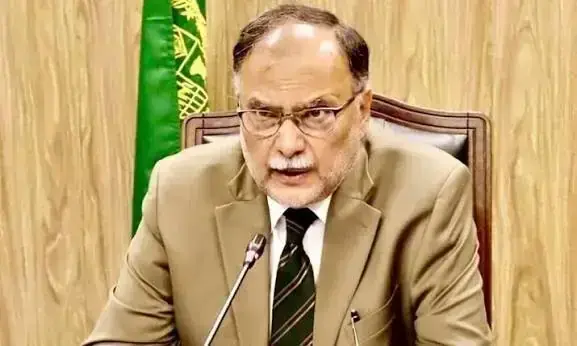
Federal Minister for Planning, Development and Special Initiatives Ahsan Iqbal declared on Friday that Pakistan aims to achieve a USD 1 trillion economy by 2035, but emphasized that this target is not merely a numerical GDP goal. The minister addressed a delegation of Harvard Business School students, explaining that Pakistan's primary economic challenge is transforming macroeconomic stability into sustained growth, increased productivity, exports, investment, and employment.
Iqbal urged the students to view Pakistan not only through its challenges but through its vast potential, citing factors such as its population of nearly 260 million, a young demographic, strategic location, abundant agricultural and mineral resources, growing digital economy, and a strong global diaspora.
To break the recurring cycle of boom, external account pressure, stabilization, and slowdown, Iqbal proposed restructuring the economy around productivity and exports, stating that stabilization alone is insufficient for progress. He introduced URAAN Pakistan, a national transformation framework centered around the 5Es: Exports, Enterprise and Employment; E-Pakistan and the digital economy; Environment, Climate Change, Food, and Water Security; Energy and Infrastructure; and Equity, Ethics, and Empowerment.
Iqbal emphasized the importance of productivity, quality, and innovation as key drivers of Pakistan's future competitiveness, aiming to create a national culture around the PQI principles so that "Made in Pakistan" becomes globally recognized for reliability, quality, and value.
The minister highlighted the role of human capital, stressing that Pakistan's most valuable resource is its people and warning that a young population could become a demographic burden unless supported by education, nutrition, healthcare, skills, and employment. He noted that artificial intelligence presents a historic opportunity for developing nations, but countries that fail to develop technological capabilities risk falling behind in the global intelligence landscape.
Iqbal urged Pakistan to not only consume but also produce and adapt emerging technologies such as AI, biotechnology, advanced manufacturing, agriculture, and space sciences.
Addressing climate change, Iqbal argued that climate resilience must be viewed as an integral part of national development, directly impacting fiscal stability, food security, infrastructure, public health, and poverty. He also outlined the evolving role of the China-Pakistan Economic Corridor, stating that while the initial phase focused on infrastructure and energy, the subsequent phase should emphasize industrial cooperation, technology transfer, agriculture, exports, and business-to-business partnerships.
Iqbal stressed that the government alone cannot drive national transformation; the private sector must play a crucial role in entrepreneurship, innovation, and competitive investment. He emphasized the importance of continuity in policies over time, stating that successful nations share the characteristic of consistent policy direction.
Finally, Iqbal invited the Harvard students to consider Pakistan as an investment and entrepreneurship opportunity, encouraging them to envision a future where every young Pakistani, regardless of background, can attain a quality education, develop valuable skills, secure productive employment, start a business, and confidently envision a brighter future.
He emphasized that the true measure of development is whether such opportunities can be accessed by all citizens of Pakistan.
Written by urgent.news from Business Recorder's reporting — not their text. Machine-written — may contain errors; check the original before relying on it.