What leeches reveal about movement
Lidia Szczupak turned to the animals to explore how the nervous system coordinates movement.
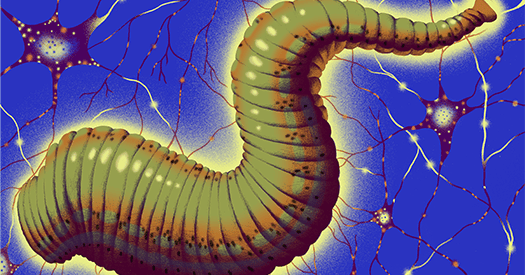
Lidia Szczupak turned to the medicinal leech, Hirudo verbana, to explore how the nervous system coordinates movement. When she found herself struggling to study neurons shaping fast and slow muscle fibers in toads, Szczupak switched to leeches after learning of their potential from neuroscientist John Nicholls. Leeches have 21 midbody segments with identical sensory and motor neurons, making them an ideal model for studying motor control.
Their simplicity allows researchers to perturb neurons and circuits to uncover their role in movement. Even without a brain or sensory inputs, individual ganglia can produce rhythmic motor activity and coordinate with one another. Each segment also uses inhibitory input to modulate motor neurons, shaping specific phases of crawling.
Szczupak spoke to The Transmitter about the leech's balance, movements not requiring its brain, and what its simplicity can offer neuroscience. When moving, leeches must consider measures to keep their balance, elongating their front while leaving the center of mass at the back until they feel safe, then moving their center of mass. The nervous system coordinates this movement through ganglia signals and feedback loops, with anterior ganglia instructing posterior ones, yet both communicate to regulate movement.
However, the field of leech research is small, with few labs using the animal for neurophysiological studies. This is partly due to the lack of genetic tools and difficulties in culturing embryos outside of their cocoons. Improving these tools would greatly benefit research on leeches and their potential to advance neuroscience by providing a clear way to check hypotheses about network function.
Written by urgent.news from The Transmitter's reporting — not their text. Machine-written — may contain errors; check the original before relying on it.