Sensex Swings Over 2,200 Points During BSE Closing Auction Session On Derivatives Expiry Day
The Sensex witnessed sharp intraday volatility during the Closing Auction Session (CAS) on the BSE on Thursday, coinciding with the first monthly expiry of derivatives contracts since the new mechanism was introduced. Between 3:18 pm and 3:23 pm, the Sensex plunged by more than 2,200 points, before rebounding nearly 2,000 points over the following minutes. The index ultimately closed at 76,934,…
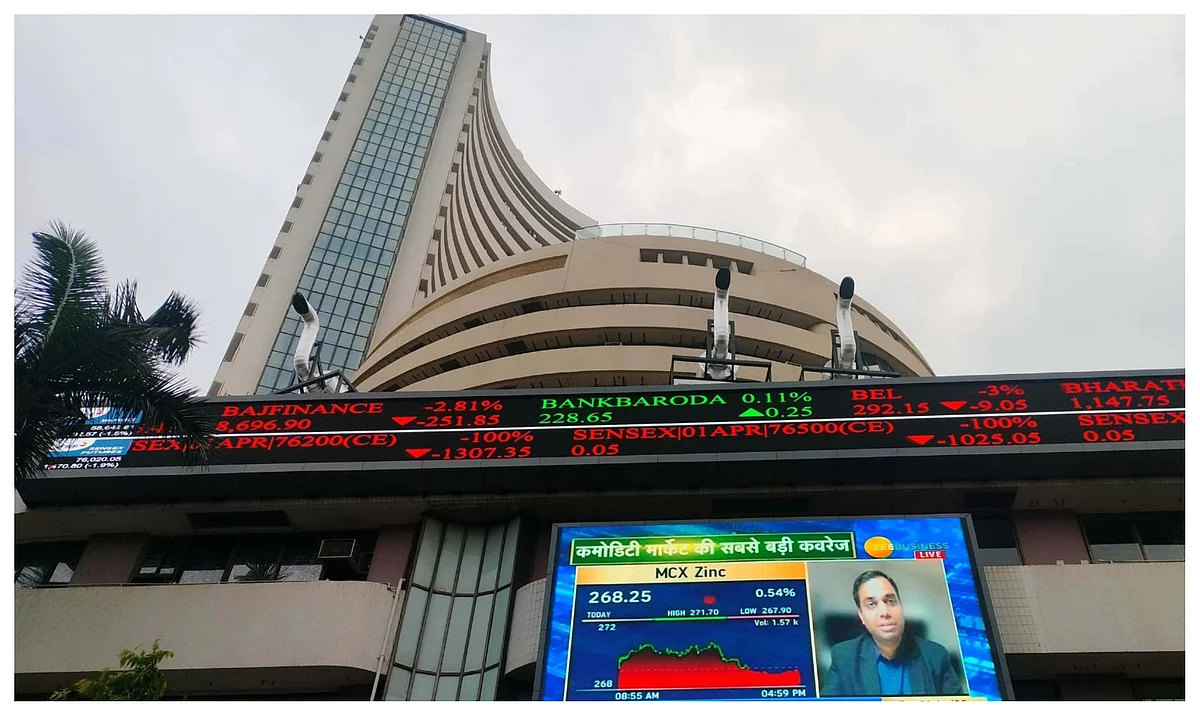
On Thursday, the Bombay Stock Exchange (BSE) witnessed significant intraday fluctuations in the Sensex during the Closing Auction Session (CAS), coinciding with the first monthly expiry of derivatives contracts. The Sensex plummeted by over 2,200 points between 3:18 pm and 3:23 pm, before regaining nearly 2,000 points in the subsequent minutes. Ultimately, the index closed at 76,934, down 539 points from the preceding session.
The Nifty, another major index, also experienced notable movements during the same timeframe, albeit to a lesser extent. It dropped more than 100 points between 3:18 pm and 3:22 pm, only to recover some of the losses and conclude at 24,091, falling by 117 points.
Several major stocks within the Sensex faced substantial price swings during the auction period. Reliance Industries, the largest constituent by weight, saw its shares plummet from around ₹1,280 to ₹1,250 before recovering and settling at ₹1,288. Other major stocks like HDFC Bank, ITC, and Bharti Airtel also exhibited significant price volatility during the CAS window.
The CAS, introduced by the Securities and Exchange Board of India (SEBI) on August 3, serves to determine closing prices for approximately 200 stocks with active equity derivatives contracts. Non-derivative stocks continue to utilize the VWAP-based system. During CAS, eligible stocks bid in an auction following the regular trading session, with matched orders establishing the final closing price.
SEBI Chairperson Tuhin Kanta Pandey has described CAS as a crucial market microstructure reform, aimed at enhancing price discovery and curbing the impact of last-minute orders. He has emphasized that dependable closing prices are essential for indices, passive investment products, and mutual fund Net Asset Value (NAV) calculations. Pandey has also highlighted that indicative prices and random closing times bolster transparency and diminish attempts to manipulate the final price.
SEBI is presently monitoring market feedback and has indicated a potential framework modification if deemed necessary. Pandey has further noted that discrepancies between index levels at the conclusion of regular trading and CAS closing values have decreased since the implementation of the CAS mechanism.
Written by urgent.news from Free Press Journal's reporting — not their text. Machine-written — may contain errors; check the original before relying on it.