Qatari women: A journey of empowerment
Under a legislative and institutional system that has consolidated the status of Qatari women, the journey of empowering them has become a model that reflects investment in human beings and their role...
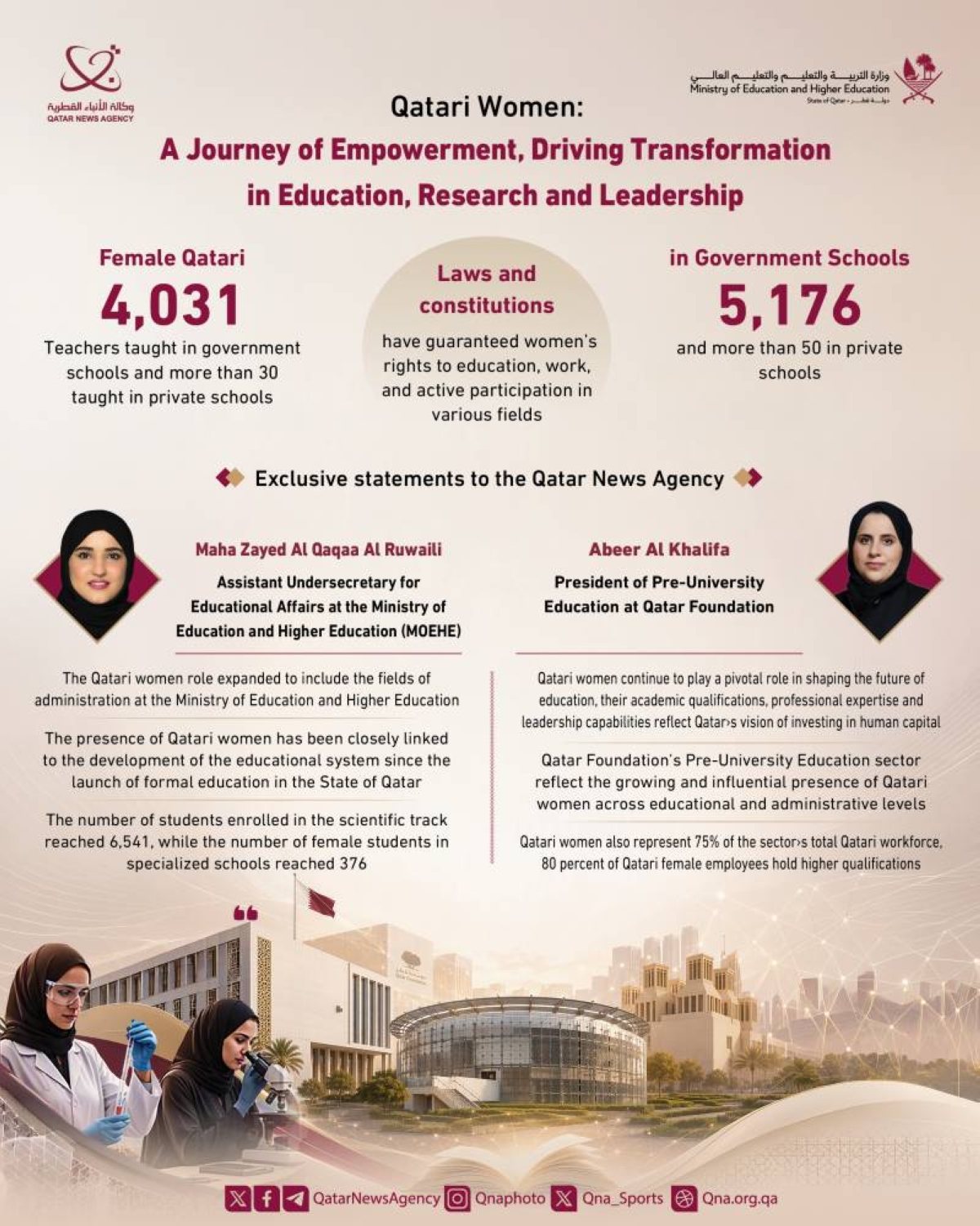
In Qatar, the empowerment of women has evolved into a model rooted in a system that values human investment and societal development. The legal framework guarantees women's rights to education, employment, and active participation across various sectors. This supportive environment encourages women to pursue leadership and decision-making roles, transcending traditional roles. Feminist models have enabled women to transition from academic positions to fields like research, leadership, and knowledge creation.
The educational sector has seen significant female participation, with 4,031 Qatari women teachers in government schools and over 30 in private schools. In the administrative sector, there are 5,176 female Qatari educators in government schools and more than 50 in private institutions. Assistant Undersecretary for Educational Affairs Maha Zayed Al Qaqaa Al Ruwaili highlighted that women's presence in the education system began with the launch of formal education in Qatar, where they played crucial roles in building modern schools and later expanded into administration, guidance, supervision, research, and development.
The appointment of women in high-ranking positions marks a milestone in the journey of Qatari women in education. Sheikha Ahmed Al Mahmoud was the first Qatari woman to become the Minister of Education in 2003, followed by Buthaina bint Ali Al Jabr Al Nuaimi in 2021 and Lolwah bint Rashid bin Mohammed Al Khater in 2024. This continuity underscores the importance of women in top executive roles.
Empowering women extends beyond ministerial positions. Women hold numerous leadership, supervisory, and mentorship roles, including assistant undersecretaries, department directors, and heads of sections. This active female presence confirms their pivotal role in leading and shaping the educational process. In the 2025/2026 academic year, the number of female students in scientific and specialized tracks increased by 4.2%, from 6,541 to 6,541, and in specialized schools, the number grew by 12.2%, from 376 to 376.
These statistics reflect the growing trend of female students pursuing scientific and specialized paths, aligning with future needs and enhancing their presence in science, technology, and specialized fields. The Assistant Undersecretary emphasized that investing in women involves integrating female talents in leading, supervising, and teaching specialized educational, technical, and banking institutions, such as the Qatar Technical Secondary School for Girls, Qatar School of Banking and Business Administration for Girls, and Qatar Schools of Science and Technology for Girls.
This approach fosters integrated educational environments that open promising horizons for female students in science, technology, innovation, and financial sectors.
Written by urgent.news from Gulf Times's reporting — not their text. Machine-written — may contain errors; check the original before relying on it.